
- Type
- Alliums
- Difficulty
- Easy
- Season
- Year-round
- Sowing
- From bulb scale
Garlic
Allium sativum
Allicin · the sulfur compound behind the aroma
When garlic is minced or crushed, its alliin converts into allicin, the compound behind the pungency and aroma and the one most often examined in research on garlic. As an overwintering crop, garlic is planted in fall (October to November) and harvested the following early summer. Once it's in the ground, it asks for very little attention, which makes it a great pick for first-time gardeners.
Year-Round Calendar
- 1
- 2
- 3
- 4
- 5
- 6
- 7
- 8
- 9
- 10
- 11
- 12
- 9
- 10
- 11
- 5
- 6
- 7
Where It Grows
- Main producer Accounts for more than three-quarters of world production. Shandong and Henan are the centre of it.
- Major producer Second in production. Grown as a winter crop on the dry inland plains of Madhya Pradesh, Rajasthan and elsewhere.
- Major producer Third in production. Grown in the dry winter season, avoiding the rains.
- Major producer Grown in winter on irrigated land in the Nile Delta.
-
Major producer
Around fifth in the world for production. The crop divides into warm-climate types in the south and cold-climate types in the central interior. Harvest May, June, July
- 5
- 6
- 7
-
Major producer
Castilla-La Mancha is the growing region, and it supplies a large share of Europe's crop. Harvest June, July
- 6
- 7
Garlic is taken to have originated in Central Asia, around the Tian Shan range; since it cannot be pinned to any one country, no country-of-origin row has been given. It spread east and west along the Silk Road and is now grown anywhere in the temperate and subtropical zones, but production leans heavily towards China. Most growing areas lie in the Northern Hemisphere, so the harvest bunches into May to July, and Argentina and Chile in the Southern Hemisphere lift their crop in November and December to fill the gap between.
- Optimum
- 15~20℃
- Range
- 5~25℃
- Hardiness
- Hardy
- Day length
- Long-day
Garlic puts on leaf in cool weather. What decides when the bulb divides and the cloves set is the cold of winter and the lengthening days of spring. Without enough cold the bulb never divides and stays a single undivided bulb, and above 25℃ the leaves dry off and the bulb stops sizing up.
In Korea Nationwide
Planted in autumn, overwintered (left in the ground through the winter), and lifted in early summer the following year. The warm-climate types of Jeju, South Jeolla and South Gyeongsang and the cold-climate types of inland South Chungcheong and North Gyeongsang differ in the month they are planted and the month they are lifted. Seosan and Taean in South Chungcheong, Uiseong in North Gyeongsang, Goheung in South Jeolla, and Jeju are the well-known areas.
- 9
- 10
- 5
- 6
- 10
- 11
- 6
- 7
How to grow
- Light
- Somewhere sunny
- Soil and depth
- 25cm deep with good drainage
- Spacing
- 15cm
- Watering
- Moderate; almost none through winter
- Feeding
- Base dressing at planting plus one feed in early spring
- Harvest
- The following June, when about half the leaves have yellowed
What makes the difference. Plant in October and let it overwinter. Pull the flower scape in spring or the bulb stays small
Common problems
- Leaf blight You will see Tips die back and it spreads What to do Improve drainage; avoid repeat planting
This page describes how a crop is grown and used. It does not claim health effects for any food, nor is it intended to prevent or treat disease. Component and study notes are references only and do not mean the same result occurs in people. Consult a medical professional about health concerns.
Health Benefits
The blood-pressure studies looked at supplements. The clinical trials that examined blood pressure used garlic supplements, which is not the same condition as eating garlic as food. Meta-analyses pooling those supplement trials reported changes in blood-pressure readings, but that is not a result to be copied across to the garlic that goes into cooking.
The lipid research also looked at extracts and supplements. The trials that examined blood lipids used standardized garlic extracts or supplements, which is not the same condition as eating garlic as food. Several reports have taken up organosulfur compounds from allium plants alongside lipids, but what garlic does as a food has to be stated separately.
Glucose metabolism · no conclusion has settled. Systematic reviews of glucose metabolism come out mixed. Supplement forms and trial designs vary from study to study, so what can be said today reaches only as far as the fact that no conclusion has settled.
Liver markers · nothing confirmed. There are garlic supplement studies that took liver enzyme levels as their marker, but the results are inconsistent. It is more accurate to write that nothing has been confirmed in modern terms.
Nutrition
- Allicin (Organosulfur compound) — Formed when a clove is crushed; source of the pungency and aroma
- Selenium and potassium (Abundant) — Trace minerals
Allicin When garlic is crushed or cut, the cells break down and an enzyme called alliinase converts alliin, a tasteless and odorless precursor, into allicin. It is the compound behind garlic's characteristic pungency and aroma, and it is interesting that it is barely detectable in an intact bulb.
Organosulfur compounds Allicin is unstable and over time converts into stable organosulfur compounds such as diallyl disulfide (DADS), diallyl trisulfide (DATS) and S-allyl cysteine (SAC). Black garlic in particular concentrates a rich supply of SAC, which causes less gastric irritation than allicin.
Vitamins & minerals Vitamin B6 and vitamin C, selenium and manganese are relatively abundant. The amount eaten at one time is small, so the daily recommended intake is hard to reach, but frequent use as a seasoning makes the cumulative intake sizable enough to matter as a source of micronutrients.
Aged garlic extract (AGE) This is the form in which raw garlic is aged at low temperature over a long period so that allicin converts into water-soluble organosulfur compounds including SAC. Stable composition and low gastric irritation make it well suited to processing into supplements, and it is often used as a standardized sample in clinical research on garlic. Anyone taking an anticoagulant or antiplatelet medicine, or facing surgery or a procedure, should check with their medical team before using a garlic supplement.
Pairings
○ Meats such as pork and beef — Garlic helps the body digest the protein in meat while taming gamey and fishy odors. Notably, allicin binds with vitamin B1 to form allithiamine, a highly absorbable form, so pairing garlic with B1-rich pork delivers a genuine nutritional synergy that is well established in Korean food science.
○ Honey — Garlic honey — peeled cloves left to steep in honey — is a long-standing household preparation. The sweetness covers the sharp bite of raw garlic, which makes it easier to take for anyone who cannot chew a raw clove. Aged black garlic is also stirred into honey and thinned with water.
○ Ginger — Garlic and ginger are both considered warming foods, so using them together strengthens their effects. Brewing the two and drinking the decoction for chills from a cold or stomach pain from cold exposure is a remedy passed down for generations in both Korean and Chinese traditions. Ginger
○ Olive oil — In Mediterranean cooking, garlic and olive oil are the most basic pairing. Some of garlic's organosulfur compounds, including allicin, convert to fat-soluble forms, so eating them with olive oil improves absorption, while the garlic aroma infuses the oil and deepens the flavor.
△ Large amounts with honey (disputed) — Some traditional herbal texts consider garlic and honey eaten together in quantity to be incompatible, but modern food chemistry offers little support for this. At normal dietary levels the combination is fine—worth noting, in fact, that honey-garlic preparations have long been an established traditional remedy.
△ Anticoagulants and upcoming surgery — Garlic has been reported to inhibit platelet aggregation, so garlic supplements or high-dose extracts taken alongside an anticoagulant such as warfarin, or an antiplatelet medicine, can raise the risk of bleeding. Culinary amounts are rarely a problem, but anyone on these medicines is safer keeping intake steady rather than swinging it up or down. Before surgery or any procedure, tell the medical team that a garlic supplement is being taken.
△ Too much raw garlic at once — The Donguibogam counts garlic among the strong-smelling pungent vegetables and warns against eating it long and in quantity. In modern terms as well, several raw cloves on an empty stomach can bring heartburn and irritation to anyone with a sensitive stomach lining or reflux symptoms. Keep raw portions small; cooking makes garlic far gentler.
Varieties
- Hanjihyeong (cold-region six-clove type) (Bulb) — Planted in the central and northern regions. Six thick cloves, long storage, lifted in June or July.
- Namdo (warm-region southern type) (Bulb) — Planted early in autumn in the south and lifted in May or June. Many small cloves, weak to hard frost.
- Daeseo type (Bulb) — Among the largest bulbs of the warm-region garlics. Mild heat, good roasted, but shorter storage life.
- Elephant garlic (Bulb) — Closer to leek than to true garlic. Fist-sized bulbs with gentle flavour, usually roasted whole.
Source: Rural Development Administration (Nongsaro)
Stories about Garlic
Garlic: Health as the Donguibogam Saw It
Tuck a few cloves into the ground in autumn and you'll pull up plump bulbs the following summer. Here's how Korea's great classical medical text read this everyday crop — and where its account meets what we know today.
Dusty Days in the Garden, and What One Clove of Garlic Is Good For
A study published this year looked at allicin, the compound that forms when garlic is crushed, in lung cells and mice exposed to silica dust. Here's what it found, what it doesn't mean, and how to handle both the dust and the garlic.
Medicine Works Better in a Well-Tended Body — and That Starts at the Table and in the Garden
A research review finds that diet and daily movement influence how antibiotics are absorbed, distributed, and broken down in the body — and may even play a role in how resistance develops. Good news for anyone who spends their evenings among the rows.
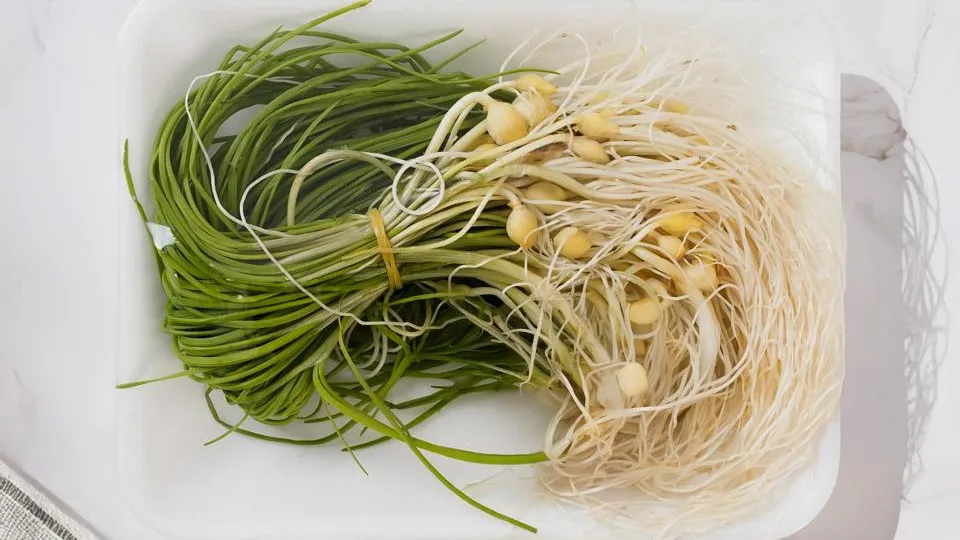
Korean Wild Chive: What Dongui Bogam Said About Its Health Benefits
Korean wild chive turns up almost unbidden in a winter-rested garden, and it has been welcome on the Korean table for centuries. The Dongui Bogam, the landmark 1613 Korean medical encyclopedia, classified it as a warming food for digestion — a view that aligns surprisingly well with what modern nutritional science notices in the same plant.