
- Type
- Fruiting Vegetables
- Difficulty
- Moderate
- Season
- Summer
- Sowing
- Transplant
Okra
Abelmoschus esculentus
Mucilage and dietary fiber in a slender, slippery pod
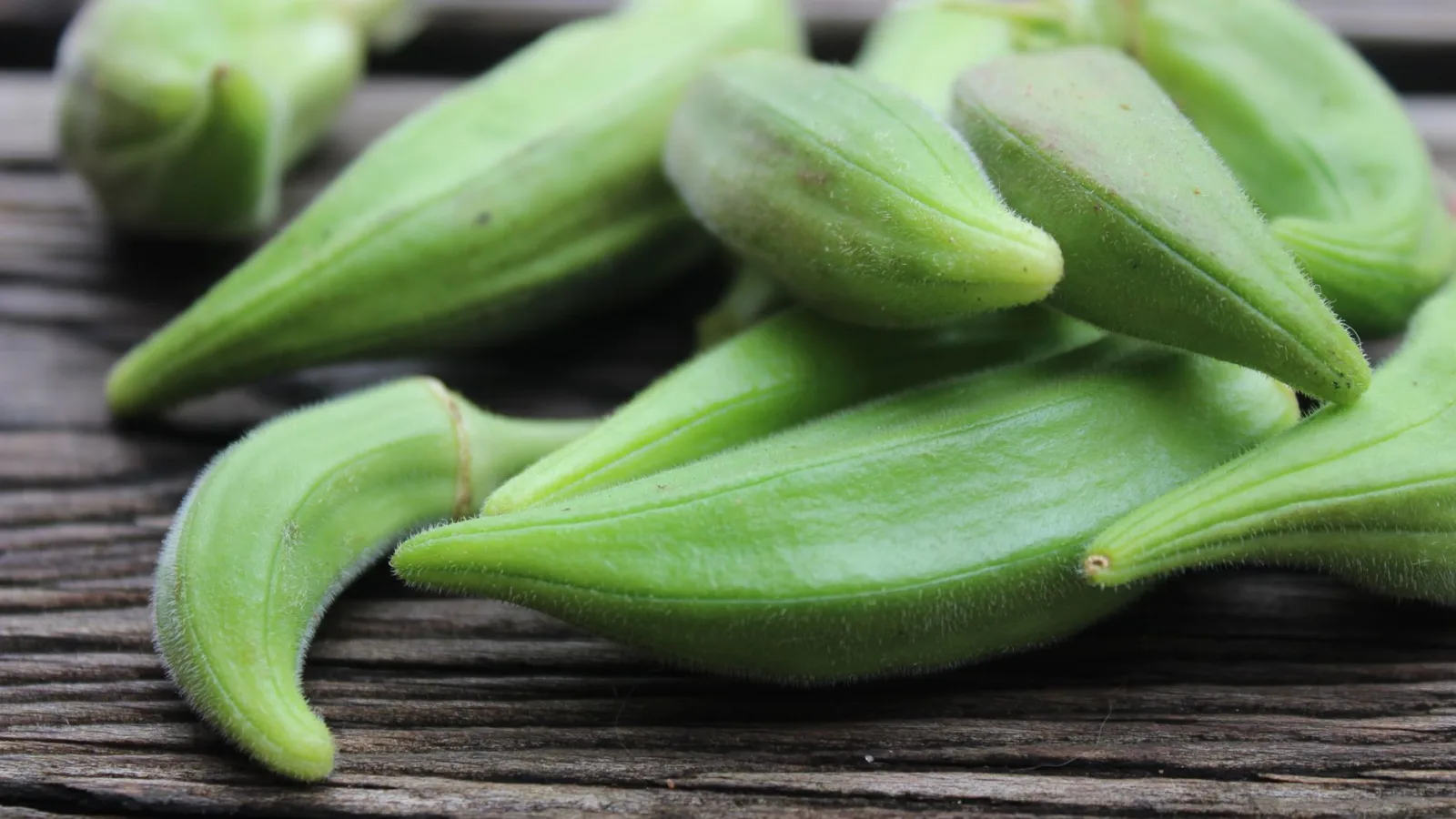
Okra is a member of the mallow family that originated in Africa, grown for its young pods, which release a slippery mucilage when sliced. That mucilage is a soluble dietary fiber built from pectin-class polysaccharides, and not the animal glycoprotein called mucin that it is often mistaken for. Pods want picking at finger length, 5-7 cm; a day or two late and the fibers stiffen past chewing. Through summer it is a crop to look over every day. The cross-section is star-shaped, and okra is blanched, stir-fried, or added to stews and curries, where it lends a natural thickness. It is a relatively new crop in Korea, with no entries in traditional Korean medical texts.
Year-Round Calendar
- 1
- 2
- 3
- 4
- 5
- 6
- 7
- 8
- 9
- 10
- 11
- 12
- 4
- 5
- 7
- 8
- 9
Where It Grows
- Main producer Accounts for most of the world's output. Production is split between a rainy-season crop and a summer crop, which stretches the supply over a long period.
- Main producer The largest producing country in West Africa, where the crop is timed to the rainy season.
- Major producer Grown on irrigated land along the Nile.
- Major producer Irrigated land in the Niger River basin is the main producing area.
- Major producer Widely grown as a summer vegetable in Punjab and Sindh.
Its native range runs from the East African highlands across to West Africa, and because no single country can be pinned down, no country-of-origin entry is given here. It spread by way of Egypt into West Asia and India, and crossed the Atlantic to establish itself in the American South as well. Today India alone accounts for most of the world's production.
- Optimum
- 25~30℃
- Range
- 18~35℃
- Hardiness
- Not hardy
- Day length
- Short-day
Tropical in origin, it takes little harm from heat but is killed outright by frost. Once temperatures fall below 18℃, flowers and pods set poorly. It is known as a short-day crop, setting flower buds as the days shorten, but many cultivated varieties have only a weak response to day length.
In Korea Nationwide
A single-season summer crop. The further south, the earlier the harvest begins and the longer it continues; in the central region it runs from late July until the first frost.
How to grow
- Light
- It wants a lot of sun and loves the heat
- Soil and depth
- 25cm deep
- Spacing
- 40cm
- Watering
- Steady
- Feeding
- Every two or three weeks
- Harvest
- At 5 to 7cm while young. A day or two late and it is too fibrous to eat
What makes the difference. Leave it and it becomes inedible almost overnight. This is a crop you look at daily. Wear gloves — the pods are bristly
Common problems
- Aphids You will see Sticky new growth What to do Wash them off
This page describes how a crop is grown and used. It does not claim health effects for any food, nor is it intended to prevent or treat disease. Component and study notes are references only and do not mean the same result occurs in people. Consult a medical professional about health concerns.
Health Benefits
Mucilage and dietary fiber (modern view). Okra's slippery mucilage is a soluble dietary fiber built from pectin-class polysaccharides. It is frequently mentioned in connection with gut health and blood-sugar buffering, though the human evidence remains limited.
Nutrition
- Mucilage (a pectin-class polysaccharide) (The slippery substance released from a cut surface) — A soluble dietary fiber
- Dietary fiber and vitamin C (Present in the young pod) — Other components present in the pod
Mucilage (a pectin-class polysaccharide) This is the identity of the slippery substance released when okra is cut: a soluble dietary fiber reported to be pectin-class. Mucin, the word often reached for, is a glycoprotein made by animal mucous membranes and a different substance. The mucilage runs most freely while the pod is young; once a pod passes 5-7 cm the fibers stiffen, and what remains is a tough core rather than the silky thread. It comes up in discussions of gut health and the post-meal blood glucose response, though the evidence in humans is limited.
Dietary fiber & vitamin C Insoluble dietary fiber and vitamin C are also present. The young pod carries both together.
Pairings
○ Bonito flakes and soy sauce — Blanched okra tossed with bonito flakes (katsuobushi) and soy sauce, a Japanese-style side dish that plays up the pods' slippery texture.
○ Curry and stew — Added to a curry or stew, okra's mucilage gives the dish a natural body and thickness.
○ Blanched with chojang — Quickly blanched and dipped in chojang, a tangy Korean red-pepper-and-vinegar sauce, for a texture that's both crisp and silky.
Varieties
- Green okra (Seedling transplant) — The common form, with ridged five-sided pods. Pick them at finger length before they turn stringy.
- Red okra (Seedling transplant) — Red pods that stand out in the bed. They turn green when cooked, so use them raw to keep the color.
- Round-pod types (Seedling transplant) — Smooth round pods that stay tender even when they size up, forgiving if harvests get delayed.
- Dwarf types (Seedling transplant) — Short plants that need little staking, which makes them workable in pots and on balconies.
Source: Rural Development Administration (Nongsaro)