
- Type
- Roots & Stems
- Difficulty
- Easy
- Season
- Spring·Fall
- Sowing
- From seed
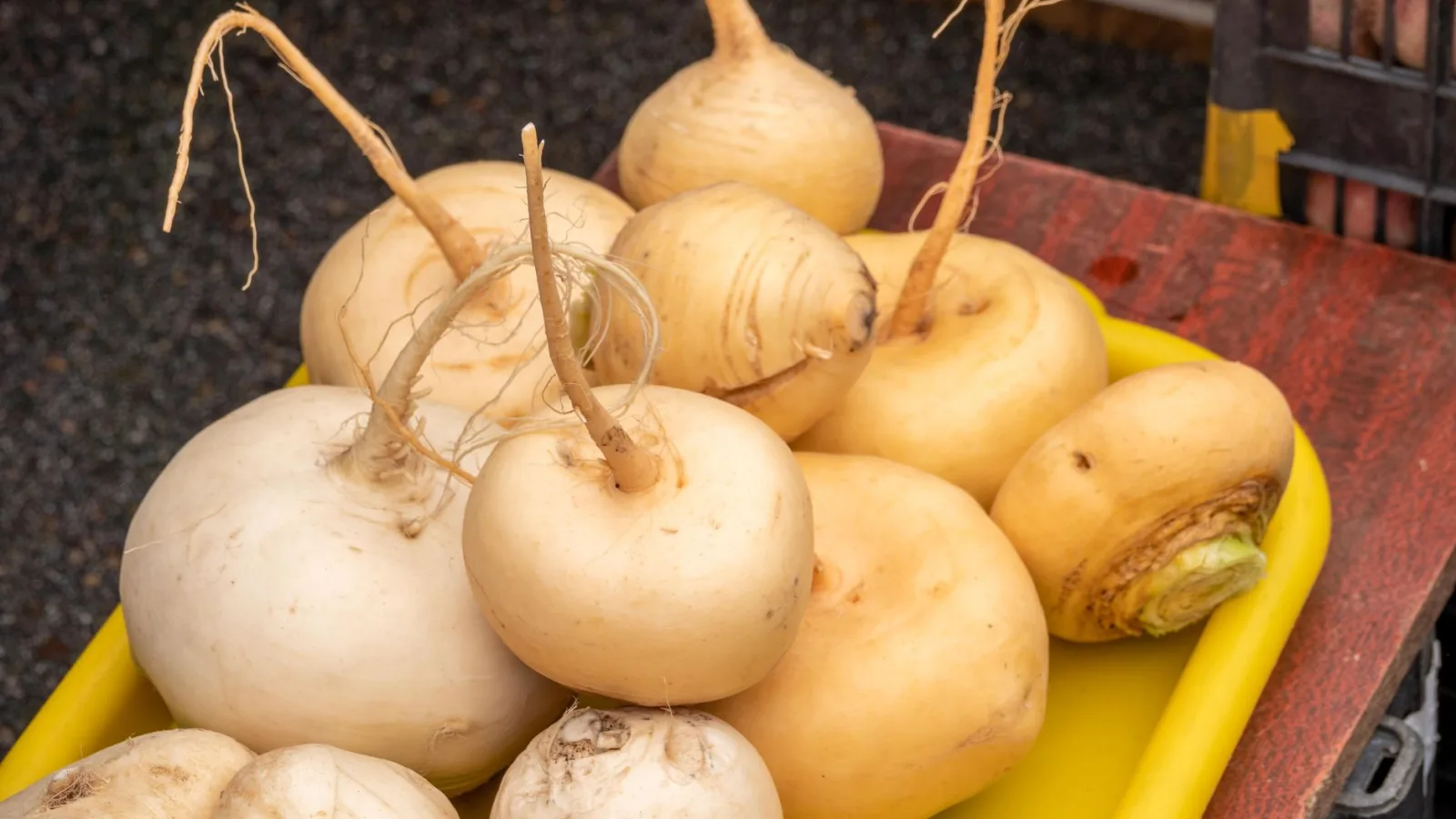
Turnip (Sunmu)
Brassica rapa
Glucosinolates give this root its sharp, peppery bite
The turnip (sunmu) is a brassica root vegetable recorded in the Donguibogam, the classic 17th-century Korean medical text, under the name mancheong (蔓菁). The text sets it down as a vegetable gathered in every season: shoots in spring, leaves in summer, stalks in autumn and roots in winter. That is an old record and differs from present-day judgement. Kanghwa Island turnips are especially famous, and their sharp, slightly pungent flavor comes from glucosinolates (mustard-oil glycosides), the same compounds found in radishes and mustard greens. Baby types are pulled 40 to 60 days after sowing, while bulking types such as the Kanghwa turnip go in at the end of August and come out in November and December, at kimjang time, most often as kimchi or fresh seasoned salads.
Year-Round Calendar
- 1
- 2
- 3
- 4
- 5
- 6
- 7
- 8
- 9
- 10
- 11
- 12
- 3
- 8
- 9
- 5
- 11
- 12
Where It Grows
- Main producer The world's largest producer of turnips.
- Major producer Turnips and swedes have long been grown here as winter field crops, yielding food for people and feed for livestock alike.
- Major producer White turnips known as kabura are grown for pickling. The Shogoin line from Kyoto is the best known.
- Major producer Across several southern states, both the roots and the leaves are harvested.
It originates in a belt running from Europe to West Asia, so no single country can be named as its home. In Europe it settled in as a winter field crop and a fodder crop; in East Asia it took a separate path as a pickling vegetable. The FAO counts turnips together with carrots under one heading, so carrots are mixed into the country rankings.
- Optimum
- 15~20℃
- Range
- 3~25℃
- Hardiness
- Hardy
A cool-climate crop: the root fills out from autumn into early winter. Frost raises its sweetness, and it stands up to late-autumn cold. Young plants that go through a spell of low temperatures will send up a flower stalk the following spring, so the window for spring sowing is kept narrow.
In Korea Nationwide
Varieties pulled small are sown in spring and autumn and harvested within two months. The Ganghwa turnip, grown for a thick root, is sown in Ganghwa, Incheon in late August and pulled in November and December; the island's sea wind and the cool of late autumn made it a growing region.
How to grow
- Light
- Somewhere sunny
- Soil and depth
- 25cm deep
- Spacing
- 20cm
- Watering
- Steady
- Feeding
- Base dressing is enough
- Harvest
- At 5 to 7cm across. Bigger and it goes woody
What makes the difference. Quicker than a radish. Sown in autumn it is ready in two months
Common problems
- Flea beetles You will see Small holes in the leaves What to do Fleece while young
This page describes how a crop is grown and used. It does not claim health effects for any food, nor is it intended to prevent or treat disease. Component and study notes are references only and do not mean the same result occurs in people. Consult a medical professional about health concerns.
Health Benefits
The old record — mancheong (蔓菁). The Donguibogam listed the turnip under the name mancheong (蔓菁) and recorded its seed separately as mancheongja (蔓菁子). This is the language of an old medical text; it bears no relation to present-day judgement or to preventing or treating disease.
Today's view — brassica compounds. Glucosinolates are the brassica compounds turnip shares with radish and mustard greens, and they give it its distinctive sharp bite. Human studies are scarce, so what can be stated at present stops at nutrient composition.
Nutrition
- Glucosinolates (Brassica mustard-oil glycosides) — The compounds behind the sharp bite
- Vitamin C and dietary fiber (Found in both root and leaves) — A water-soluble vitamin and fiber
Glucosinolates These are brassica compounds shared with radish and mustard greens; they give turnip its distinctive sharp bite and come up in discussions of antioxidant activity. Human evidence, however, is limited.
Vitamin C & dietary fiber Both the root and the leaves contain vitamin C and dietary fiber.
Pairings
○ Kimchi and seokbakji — Sunmu-kimchi made from Kanghwa turnips has a sharp, refreshing taste that is distinct from the milder flavor of regular radish kimchi.
○ Salt-cured and fresh salads — Sliced thin and lightly cured in salt, or tossed raw as a seasoned salad (saengchae), the turnip offers a crisp texture and a pleasantly pungent bite.
○ Soups and braises — Added to soups or braises, much like a radish in mutguk (radish soup), it lends a gentle, subtle sweetness as it cooks.
Varieties
- Ganghwa sunmu (Ganghwa turnip) (Seed) — A Korean landrace with a purple-stained shoulder. Its sharp bite suits kimchi and pickles.
- White turnip types (Seed) — European types that are white through the root and much milder, better for soups and braises.
- Early baby types (Seed) — Small roots pulled in about 40 days. They take little space, so they fit pots and narrow beds.
Source: Rural Development Administration (Nongsaro) · Donguibogam (Principles and Practice of Eastern Medicine)