
- Type
- Herbs & Aromatics
- Difficulty
- Easy
- Season
- Spring·Fall
- Sowing
- From bulb
Korean Wild Chive (Dallae)
Allium monanthum
Sulfur compounds · a sharply aromatic spring green
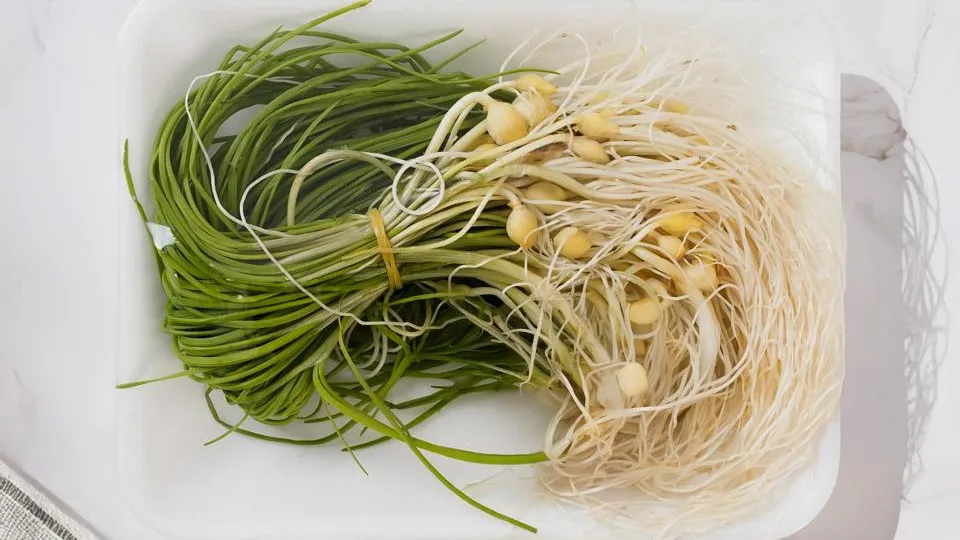
Korean wild chive (dallae) is a pungent, sharply aromatic spring green eaten whole, both its small bulb and its slender leaves. Old medical texts list it as sosan, literally small garlic: the classic Donguibogam separates garlic as daesan (large garlic) from the dallae family as sosan. That is a historical record and has no bearing on preventing or treating disease. Its biting flavor comes from the same class of sulfur compounds found in garlic. The real hazard when digging it in the wild is daffodil (Narcissus) and Lycoris, whose bulbs and leaves resemble dallae and which are poisonous. So check first that the leaves and bulb carry the sharp garlic-and-onion smell, and leave anything without that smell in the ground. It brightens spring appetites in dishes like dallae-jang (a soy-based seasoning sauce) and doenjang-jjigae (soybean-paste stew).
Year-Round Calendar
- 1
- 2
- 3
- 4
- 5
- 6
- 7
- 8
- 9
- 10
- 11
- 12
- 9
- 10
- 3
- 4
Where It Grows
-
Main producer
It grows wild in hills and fields nationwide and is also raised in cultivated plots. Seosan and Taean in South Chungcheong, and the South Jeolla area, are the known centres for cultivation and distribution. Harvest March, April
- 3
- 4
- Wild population It is found in Dongbei (Jilin and Liaoning) and in the mountain country of North China.
- Wild population It is found in central and northern Honshu and in the mountains of Hokkaido, where it is gathered as a spring green.
It is an East Asian plant, growing wild across the temperate hills and fields of the Korean peninsula, northeastern China, Japan and the Russian Far East, so it cannot be pinned to any one country. Korea is effectively the only country where it is both foraged and grown in cultivated fields, and no world production figures exist. Two plants its name is often confused with, sandallae (Allium macrostemon) and the Western chive (Allium schoenoprasum), are both separate species.
- Optimum
- 10~20℃
- Range
- 0~25℃
- Hardiness
- Hardy
It grows in the cool of early spring, then dries back at the leaf and rests in the bulb through summer. The bulbs winter over in frozen ground, and once temperatures pass 20℃ the top growth withers and the year's harvest is over. It likes damp soil in half shade.
Harvested 1–1 years after planting. The bulbs are planted in autumn, winter over, and are lifted in early spring the following year. The planting month and the harvest month do not fall in the same year. Left unlifted, the bulbs divide and come up again year after year.
In Korea Nationwide
It is common in hills, fields and field margins nationwide, and field cultivation is known on the west coast of South Chungcheong and in South Jeolla. If the winter is too mild, the leaves run up early and the fragrance thins.
How to grow
- Light
- Part shade is fine
- Soil and depth
- 15cm deep
- Spacing
- 5cm
- Watering
- When the surface dries
- Feeding
- Barely any needed
- Harvest
- Early spring, lifted with the little bulb
What makes the difference. Plant the bulbs in autumn and dig the following spring. One pot gives you enough for a meal
This page describes how a crop is grown and used. It does not claim health effects for any food, nor is it intended to prevent or treat disease. Component and study notes are references only and do not mean the same result occurs in people. Consult a medical professional about health concerns.
Health Benefits
What the Donguibogam recorded: sosan. In its Tangaekpyeon vegetable section the Donguibogam separates garlic as daesan (large garlic) from the dallae family as sosan (small garlic), and describes sosan as warm in nature and pungent in taste. That is a record of a name and its classical nature-and-taste entry, it differs from present-day judgment, and it has no bearing on preventing or treating disease.
What today's evidence shows: composition only. Dallae belongs to the Allium genus alongside garlic and Korean chive, and compositional analysis confirms it shares the sulfur compounds that give it its sharp aroma. Studies feeding dallae itself to people are scarce, so what can be stated today stops at composition.
Nutrition
- Sulfur compounds (allicin family) (pungent, sharp flavor) — the aroma compounds shared with garlic and green onion
- Vitamin C and iron (present in the leaves and bulb) — micronutrients common in spring greens
Sulfur compounds (allicin group) The sharp, pungent aroma particular to Korean wild chive comes from the same class of sulfur compounds found in garlic and green onion. They are the aroma constituents of Allium plants and are handled together at the compositional level in research.
Vitamin C and iron As befits a spring green, it carries vitamin C and iron. In nutrition science these are the nutrients discussed in connection with antioxidant activity and red blood cell formation respectively.
Pairings
○ Soy sauce (dallae-jang) — Finely chopped dallae combined with soy sauce, red pepper flakes, and sesame oil makes dallae-jang, a seasoning sauce that pairs well with rice and tofu. Sesame
○ Soybean paste (dallae doenjang-jjigae) — Stirred in at the end of a soybean-paste stew, it brings out its sharp, lively aroma.
○ Tofu and egg — Eaten with mild tofu and egg, its pungent aroma softens and mellows.
△ Foraging risk — daffodil and Lycoris bulbs — People dig daffodil (Narcissus) and Lycoris bulbs every spring believing them to be dallae. Both hold lycorine-type alkaloids that cause vomiting, diarrhoea and stomach pain, and a large helping makes a person badly ill. Smell is the test: dallae leaves and bulb give off a sharp garlic-and-onion scent, and these look-alikes give off none. The bulbs differ in size too. Dallae forms a small round bead of a bulb, while daffodil and Lycoris bulbs run as thick as an onion with layered scales. If there is any doubt at all, leave it in the ground and use plants grown or bought instead.
Varieties
- Dallae (Allium monanthum, true wild chive) (Bulb) — Pea-sized bulbs and very fine leaves; a gentler scent and a small harvest per plant.
- Sandallae (Allium macrostemon, long-stamen chive) (Bulb) — Most thick dallae sold in markets. Bigger bulbs that multiply well, so it suits a home plot.
Source: Rural Development Administration (Nongsaro) · Donguibogam (classic Korean medical text)