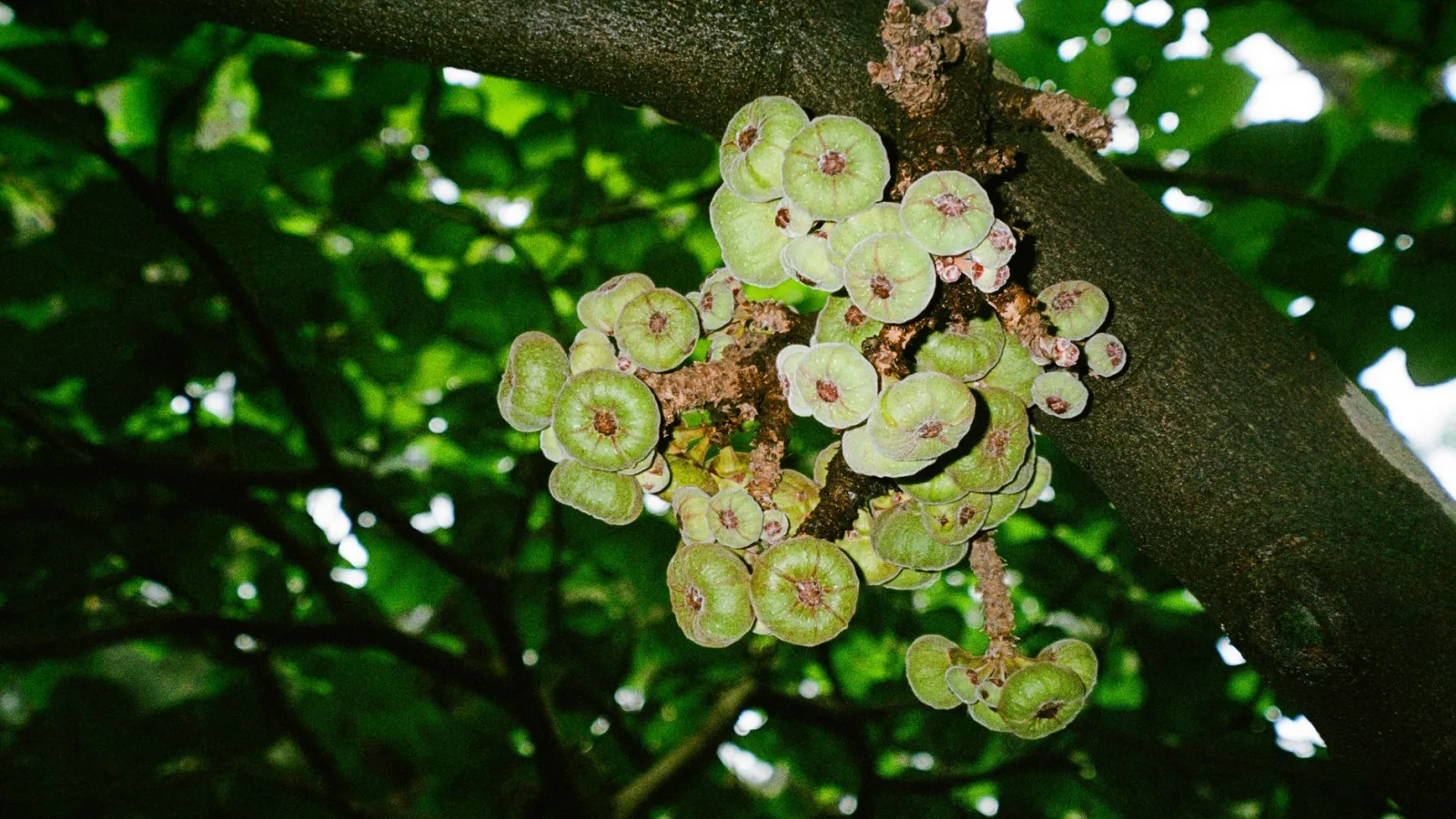
By late summer, round leaves up to 1–2 m across float at the water's edge. Their veins and stems bristle with dense spines, so you can't grab one bare-handed. This is the prickly water lily. Looking at the leaves alone, you'd never guess there's something edible underneath. Gardeners who sink a tub in one corner of the plot to grow water lilies tend to type the same questions into a search bar after seeing these leaves: Are the seeds safe to eat? Can I plant one? Is the bag of little white puffs at the store the same thing?
An Old Name Borrowed from a Rooster
The Donguibogam, Korea's classic seventeenth-century medical compendium, lists this seed in its fruits section as geomin (芡仁). It describes the plant's appearance — leaves large and crinkled like a lotus pad, and spiny — and adds a note on the name: because the fruit resembles a rooster's head, it was called gyedusil (雞頭實), "chicken-head fruit." These are the records of an old medical text, so they don't line up with today's standards. The physical description, though, matches exactly what you see at the water's edge now. The fruit's husk carries hard spines too, so getting the seeds out calls for thick gloves.
First, Can You Plant It?
In Korea, the prickly water lily is designated an Endangered Wild Species, Class II. Picking the fruit or digging up the roots at a reservoir or wetland is off-limits, and so, as a rule, are processing, distributing, storing, and transferring it. Propagating it artificially requires a permit. So for a home gardener, there is effectively no legal way to obtain seed and plant it in a tub out back. The plant's native range spans India, China, Korea, and Japan, and protection rules differ from country to country — before you move any water plant into your garden, check what applies where you live.
Where cultivation is permitted, seed goes in around April in the Northern Hemisphere and the fruit comes in through August and September. The full growing calendar and companion notes are in the fox nut crop guide.
The White Puffs in the Bag
The makhana on the store shelf wasn't foraged from the wild. It's a food grown and processed at scale in India and China and imported from there. The seeds are popped and roasted into a snack; in India they're also simmered in milk into a pudding called kheer. In Korea they've been cooked into porridge or ground into flour. So the protection rules and this snack aren't in conflict. What the rules protect is the wild prickly water lily still growing at the water's edge; what's in the bag is a farm crop raised in a managed pond.
A Seed That's Nearly All Starch
Fox nuts aren't a grain, but by composition they're close to pure starch, and that's where most of the calories come from. Among starchy seeds they run relatively high in protein, they carry potassium and magnesium, and they're nearly sodium-free. They also contain phenolic compounds such as flavonoids and polyphenols. Extracts of the seed have shown antioxidant activity in test-tube and animal studies, though whether the same effect holds in people hasn't been established. Think of them as a modest addition to a meal, nothing more.
"Nearly all starch" also means that eating a lot of them comes back as calories and a blood-sugar load. A handful at a time is about right. Old texts held that geomin had an astringent, binding quality, so if you tend toward constipation, try cutting back.
What to Do in the Kitchen
- Toast them in a dry pan, salt them, and you have a snack to eat by the handful. If you use oil, use barely any — more than that and they go soft.
- After toasting, let them cool completely before they go into an airtight container. Sealed up warm, they turn limp.
- Grind the toasted seeds and stir them into milk or rice porridge; that fills in the protein and calcium the starch alone doesn't supply. They take little chewing, which makes them easy to work into meals for older adults and small children.
- Try adding dried jujubes to the porridge or a tea. The sweetness means you can skip the sugar, and the fruit's tartness cuts the flat taste of plain starch.
Underripe seeds are astringent and hard, and difficult to eat as they are. Steam them and peel off the skins first, and wear thick gloves while you work.
There's one thing to do today. Turn over the bag in your cupboard and check the origin and cultivation labeling on the back. If it was grown rather than gathered from a pond, you can put the pan on with a clear conscience.