
- Type
- Leafy Greens
- Difficulty
- Moderate
- Season
- Spring·Fall
- Sowing
- Transplant
Cauliflower
Brassica oleracea var. botrytis
Glucosinolates and vitamin C in a white cruciferous head
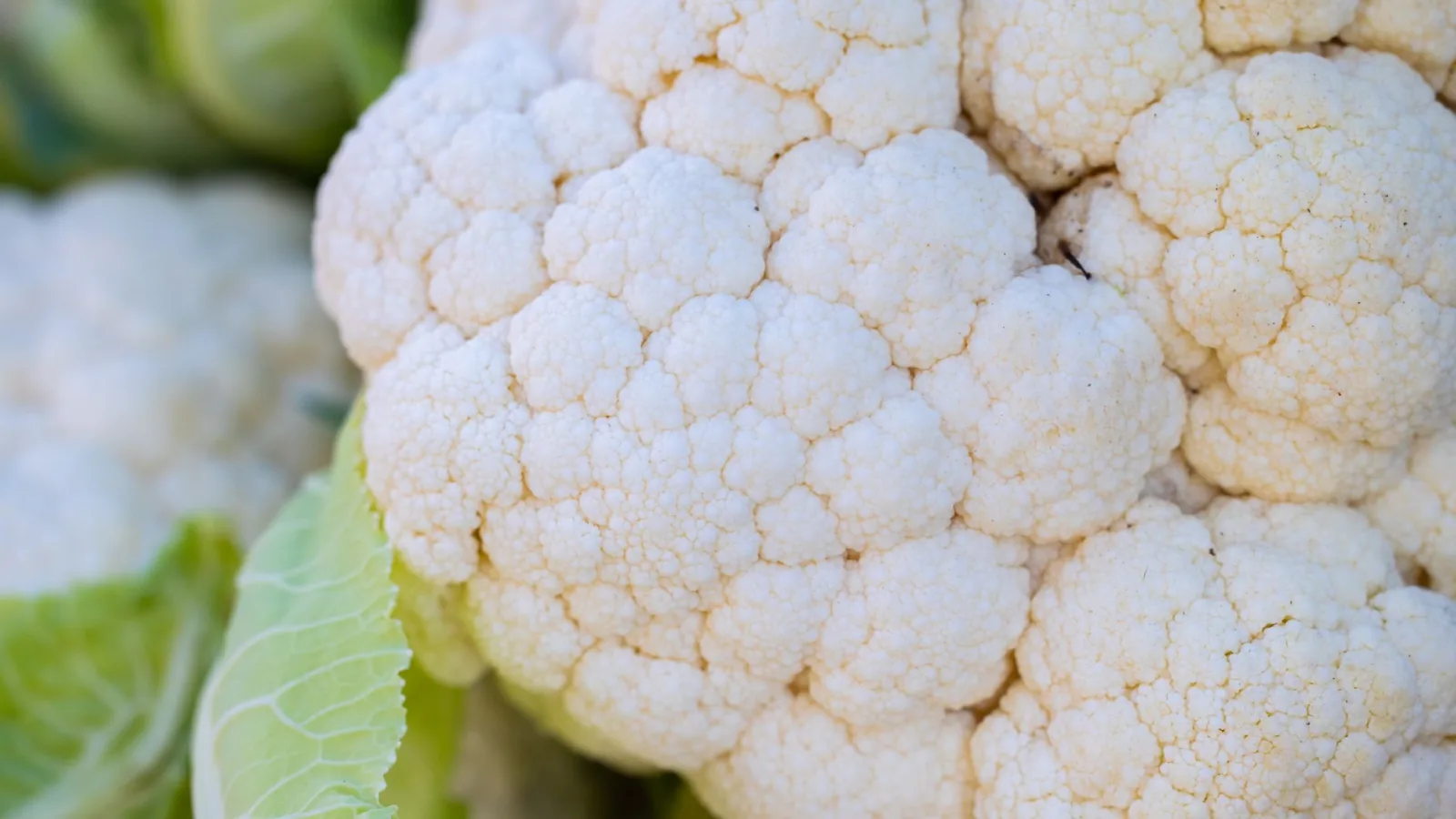
Cauliflower is a flower-bud vegetable that split off from the same cabbage lineage as broccoli. The curd holds almost no chlorophyll, so its natural color is white, but left exposed to the sun it turns yellow or purple-tinged; growers gather the outer leaves and tie them over the head to keep that from happening. It carries the glucosinolates common to the Brassica family along with vitamin C, and it is bulky for its calorie count, which is why it is minced as a stand-in for rice or potato. Research done on broccoli, a different variety of the same species, does not transfer to it unchanged. Eating a large quantity of cruciferous vegetables at once tends to cause gas, and anyone taking medication for a thyroid condition is better off speaking with their doctor before increasing the amount.
Year-Round Calendar
- 1
- 2
- 3
- 4
- 5
- 6
- 7
- 8
- 9
- 10
- 11
- 12
- 3
- 8
- 6
- 11
Where It Grows
- Main producer It takes the largest share of world production. Production splits between a winter season in central and southern China and spring and autumn seasons in the north.
-
Main producer
Production centers on the cool winter season in West Bengal, Bihar, and Uttar Pradesh. Harvest November, December, January, February
- 1
- 2
- 11
- 12
- Major producer Coastal California and the irrigated lands of Arizona split the year into summer and winter production areas, keeping supply going year-round.
- Major producer Murcia and Alicante are the source of Europe's winter supply.
- Major producer In a Mediterranean climate, open-field growing runs from autumn through spring.
- Major producer It is grown in the Guanajuato–Bajío highlands and shipped to the North American market.
The crop is thought to have originated in the eastern Mediterranean, particularly Cyprus and the Levantine coast, and its present headed form was refined in Italy. Because that is a region rather than any single country, no origin row is given. Today's growing areas divide into places where winters are mild enough to set heads in the cool season, and highlands and coasts where summers stay cool. International statistics count cauliflower and broccoli as a single item, so broccoli is mixed into the rankings.
- Optimum
- 15~20℃
- Range
- 5~25℃
- Hardiness
- Half-hardy
Cauliflower is a cool-climate crop. It sets its head only after the plant has passed through a spell of cool temperatures, so plants set out in hot weather form loose, open heads or none at all. Above 25℃ the plant runs to leaf, and a hard frost after the head has set turns it brown.
In Korea Nationwide
Most growers buy seedlings and transplant them. The lowlands get two crops — a spring crop transplanted in March for a June harvest and an autumn crop transplanted in August for a November harvest — while the midsummer supply comes from the highland (cool upland farming) areas of Gangwon, where summers stay cool.
- 3
- 8
- 6
- 11
- 5
- 6
- 8
- 9
How to grow
- Light
- Somewhere sunny
- Soil and depth
- 30cm deep or more
- Spacing
- 45cm
- Watering
- Steady
- Feeding
- Base dressing plus a feed every three weeks
- Harvest
- When the curd is about the size of a fist and still firm
What makes the difference. As soon as the curd shows, fold the outer leaves over it. Shade is what keeps it white
Common problems
- Cabbage white caterpillars You will see Holes in the leaves What to do Netting
This page describes how a crop is grown and used. It does not claim health effects for any food, nor is it intended to prevent or treat disease. Component and study notes are references only and do not mean the same result occurs in people. Consult a medical professional about health concerns.
Health Benefits
Glucosinolates and what they break down into. Cauliflower contains the glucosinolates common to cruciferous vegetables. When it is cut or chewed they meet myrosinase and turn into isothiocyanates, a reaction that is itself well established. That does not mean, however, that eating cauliflower changes the course of any particular disease.
Same species as broccoli, but not the same composition. Cauliflower and broccoli are different varieties of the same species, Brassica oleracea. The kinds and amounts of glucosinolate differ between varieties, so findings from research on broccoli do not carry over to cauliflower unchanged. Studies isolating cauliflower alone in people are scarce, so what can be said at present stops at composition.
Nutrition
- Glucosinolates (the sulfur compounds common to the Brassica family) — compounds that break down when the head is cut or chewed
- Vitamin C and dietary fiber (present in the white curd) — why the head is bulky for its calorie count
Glucosinolates These are the sulfur compounds shared across the Brassica family. The white curd of cauliflower holds almost no chlorophyll or carotenoid, but glucosinolates are present. When the head is cut or chewed they meet myrosinase and break down into isothiocyanates, which is where the characteristic aroma comes from. The kinds and amounts differ from one variety to the next, so the profile is not identical to broccoli's.
Vitamin C & dietary fiber Cauliflower carries vitamin C and dietary fiber and is bulky for its calorie count, which is how the habit of mincing it in place of rice or potato began. Vitamin C is sensitive to heat and water, so long boiling takes much of it out.
Pairings
○ Olive oil (roasted) — Brushed with oil and roasted, cauliflower turns nutty and brings out its natural sweetness.
○ Curry — Added to curry, it lends extra texture and pairs well with the spices.
○ Mashed or riced (a rice substitute) — Finely chopped or mashed, it works in place of rice to cut down on carbohydrates.
Varieties
- White type (Seedling transplant) — The common kind; tie the outer leaves over the head, since sun turns the curd yellow.
- Purple type (Seedling transplant) — Purple curds that fade once boiled, so slice them raw to keep the colour on the plate.
- Orange type (Seedling transplant) — Apricot-orange curds that hold their colour after cooking and stand out on the plate.
- Romanesco (Seedling transplant) — Lime-green heads spiralling into pointed peaks; a long season, so autumn growing is safer.
Source: Rural Development Administration (Nongsaro)