
- Type
- Leafy Greens
- Difficulty
- Easy
- Season
- Spring·Fall
- Sowing
- From seed
Curled Mallow (Auk)
Malva verticillata
Calcium and mucilage in a green that turns silky in soup
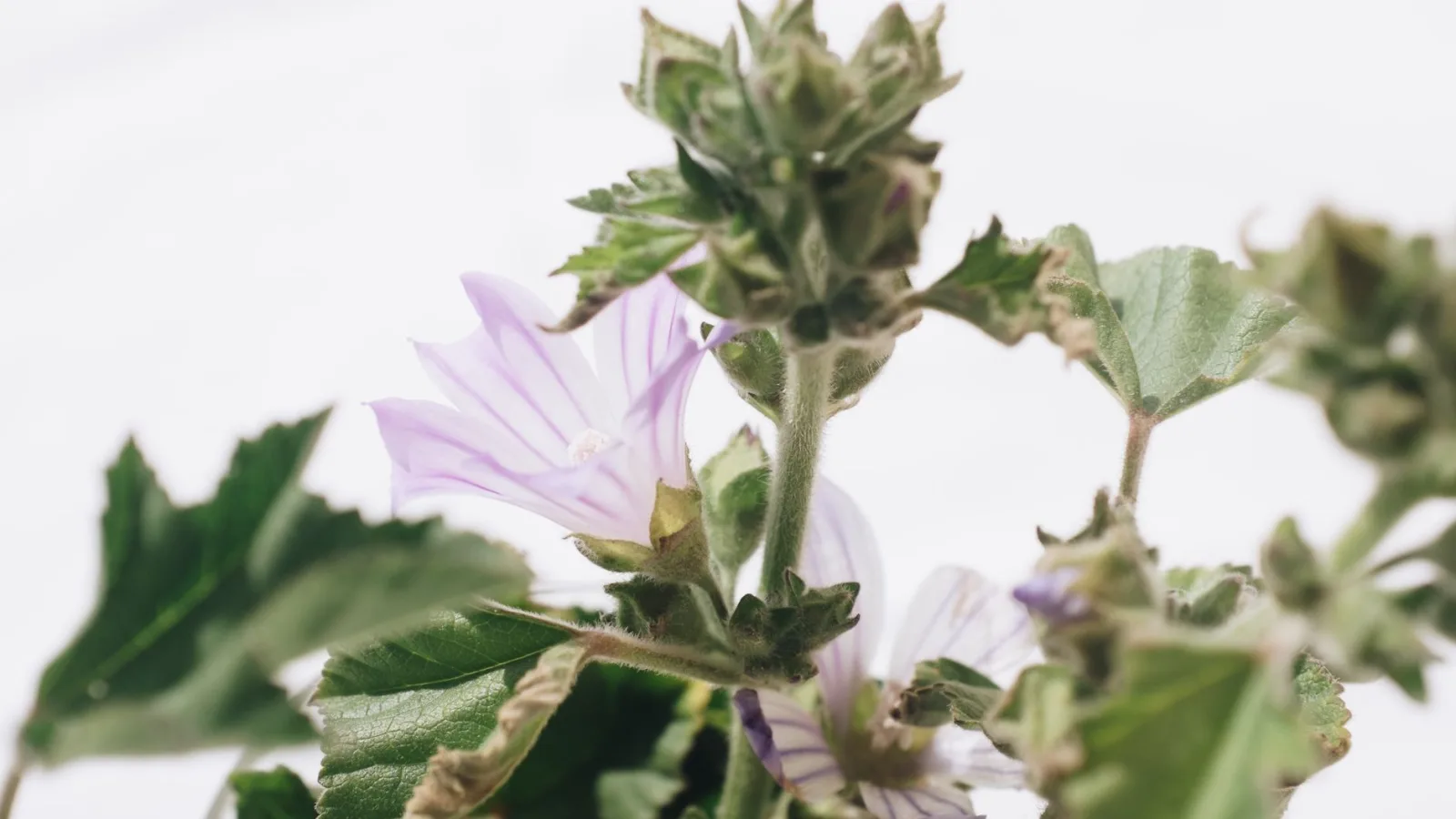
Curled mallow (auk in Korean) has been prized at the table long enough to earn an old saying: "An autumn mallow soup is saved only for the son-in-law." Its calcium content is high for a leafy green, and the mucilaginous polysaccharide that turns slippery in water gives it its distinctive softness. It is often called mucin, but mucin is a glycoprotein made by animal mucous membranes — a different substance from plant mucilage. Simmered with doenjang (Korean fermented soybean paste) into auk-guk, a hearty soup, it turns silky and savory. Grow it in spring and fall; the cool-weather autumn crop is especially tender.
Year-Round Calendar
- 1
- 2
- 3
- 4
- 5
- 6
- 7
- 8
- 9
- 10
- 11
- 12
- 3
- 4
- 8
- 9
- 6
- 10
- 11
Where It Grows
- Main producer In Sichuan, Hunan and Jiangxi it is grown as a leaf vegetable under the name donghancai ("winter cold vegetable"). Northern China also falls within the plant's native range.
-
Main producer
A kitchen-garden vegetable planted since before Korea's Three Kingdoms period, it is grown throughout the country. Harvest June, October, November
- 6
- 10
- 11
- Wild population It grows scattered in the wild, but is rarely raised as a vegetable.
- Wild population It grows wild in the fields and along the roadsides of southern Siberia.
The plant is native to temperate East Asia, from northern China to southern Siberia, and China and Korea are effectively the only places where it is grown as a vegetable. Because no global production statistics are collected for this crop, its growing areas cannot be ranked by output; the list therefore includes only the native range, the countries that grow it as a vegetable, and the countries where wild populations remain, and it stops at four rows.
- Optimum
- 18~23℃
- Range
- 8~30℃
- Hardiness
- Half-hardy
It thrives in cool, moist spots. In the high heat of midsummer the leaves turn tough and the plants send up flower stalks quickly, while autumn-sown plants grow slowly in the cool weather and keep their leaves tender. Young plants can withstand a light frost, but overwintering (carrying plants through the winter) outdoors in midwinter is difficult.
In Korea Nationwide
Seed is sown twice, in spring (March–April) and autumn (August–September). Spring sowings are harvested in June and autumn sowings in October–November, and autumn mallow, grown in cool weather, is the more tender. There is no major commercial growing area; the crop comes from kitchen gardens and market gardens on the outskirts of cities.
How to grow
- Light
- Somewhere sunny
- Soil and depth
- 20cm deep
- Spacing
- 20cm
- Watering
- It likes water. Do not let it dry out
- Feeding
- Base dressing plus a feed every two or three weeks
- Harvest
- Pick the tender tips and side shoots keep coming
What makes the difference. For soup, take only the soft shoots. Tough leaves make the broth muddy
Common problems
- Aphids You will see Sticky new growth What to do Wash them off
This page describes how a crop is grown and used. It does not claim health effects for any food, nor is it intended to prevent or treat disease. Component and study notes are references only and do not mean the same result occurs in people. Consult a medical professional about health concerns.
Health Benefits
What the mucilage does. The slippery texture of curled mallow comes from the mucilaginous polysaccharides shared across the mallow family. How it thickens once dissolved in water is the part that can be stated plainly today.
The pharmacology research used a different species, in extract form. Most of the pharmacological research on record was carried out on extracts of common mallow (Malva sylvestris), or on materials manufactured from them. That is a different species from the curled mallow (Malva verticillata) grown in a garden and simmered into soup, under a different set of conditions, so those results cannot be transferred to the food.
What has been confirmed in people. Studies looking at people eating curled mallow as a food are scarce. What has been confirmed in modern terms goes only as far as its nutrient composition, and it has nothing to do with preventing or treating disease.
Nutrition
- Calcium (High among leafy greens) — The mineral that makes up bone and teeth
- Mucilage (Present) — A polysaccharide that turns slippery in water
- Vitamins A and C (Abundant) — The vitamins typical of leafy greens
Mucilage & dietary fiber The mucilaginous polysaccharides common to plants of the mallow family (Malvaceae) turn slippery once dissolved in water. The soft, silky texture of auk-guk, the Korean mallow soup, comes precisely from this mucilage.
Polysaccharides The polysaccharides common to plants of the genus Malva are a class of compounds frequently taken up in laboratory research. Most of that work, however, was done on extracts, so it cannot be carried over as it stands to mallow eaten as a vegetable.
Calcium, iron & vitamins A, C and K Curled mallow carries calcium and iron along with vitamins A, C and K, and its calcium content ranks in the upper tier among Korean leaf vegetables. Serving mallow soup to a mother recovering from childbirth is a long-standing custom of the Korean table.
Flavonoids & phenolic acids Curled mallow contains flavonoids and phenolic acids. These belong to the polyphenol class of compounds commonly grouped together in antioxidant research.
Mucilage and the word "mucin" The slipperiness of curled mallow is sometimes called mucin, but mucin is a glycoprotein made by animal mucous membranes. Plant mucilage is a polysaccharide — long chains of sugars — and that is where the silky quality of this green comes from. It is more viscous than other leaf vegetables of the same volume, a form well suited to soups.
Pairings
○ Doenjang — Simmering mallow soup with doenjang (Korean fermented soybean paste) is a classic of the Korean table. The salty, savory depth of doenjang melds with the natural sweetness and silkiness of mallow to make one of Korea's signature soups, while the fermented soy protein and the green's minerals round out the nutrition.
○ Dried shrimp and dried anchovies — Adding dried shrimp or dried anchovies to mallow soup creates a natural calcium synergy. A soup that brings together mallow, shrimp, and doenjang is the version most commonly made in Korean homes.
○ Barley and multigrain rice — Pairing mallow soup with barley or multigrain rice makes a fiber-rich meal. The fiber from both helps prevent constipation and softens the spike in blood sugar after eating. Barley
○ Ginger — Mallow is considered somewhat 'cooling' in nature, so adding a slice of ginger can restore a warming balance. Simmering ginger into mallow soup is traditionally recommended for people with a weak stomach. Ginger
○ Postpartum recovery meals — The combination of mallow soup, seaweed soup (miyeok-guk), and multigrain rice has become a staple of postpartum recovery meals. Together they supply calcium, iron, fiber, and mucilage, supporting nutrition broadly during the recovery period after childbirth.
△ Weak digestion or loose stools — For people with a weak stomach or a tendency toward diarrhea, curled mallow—considered a 'cooling' food in traditional terms—can be hard on the system. Balancing it with warming seasonings such as ginger, doenjang (fermented soybean paste), or gochujang (red-pepper paste) is recommended.
△ Right after taking oral medication — The mucilage in curled mallow may slow drug absorption, so avoid eating large amounts immediately after taking oral medication. Leaving a gap of one to two hours is the safer approach.
△ Mallow seed (冬葵子) — The Donguibogam records mallow seed as 冬葵子, notes that it is much used as a medicinal (多入藥用), and describes its nature as extremely slippery (性至滑利). The parts eaten are the leaves and stalks; the seed is not a part that goes into the soup pot. Anyone pregnant or breastfeeding should leave the seed alone.
Varieties
- Round-leaf landrace type (Seed) — Broad rounded leaves on tender stalks. The ordinary type sown for auk-guk soup at home.
- Curled-leaf type (var. crispa) (Seed) — Leaf edges are frilled and crimped, so leaves look thicker. Picked young, they stay soft.
Source: Food and Nutrition Information