
- Type
- Roots & Stems
- Difficulty
- Easy
- Season
- Spring·Fall
- Sowing
- From seed
Korean Radish (Mu)
Raphanus sativus
Diastase · the root that turns sharp when grated
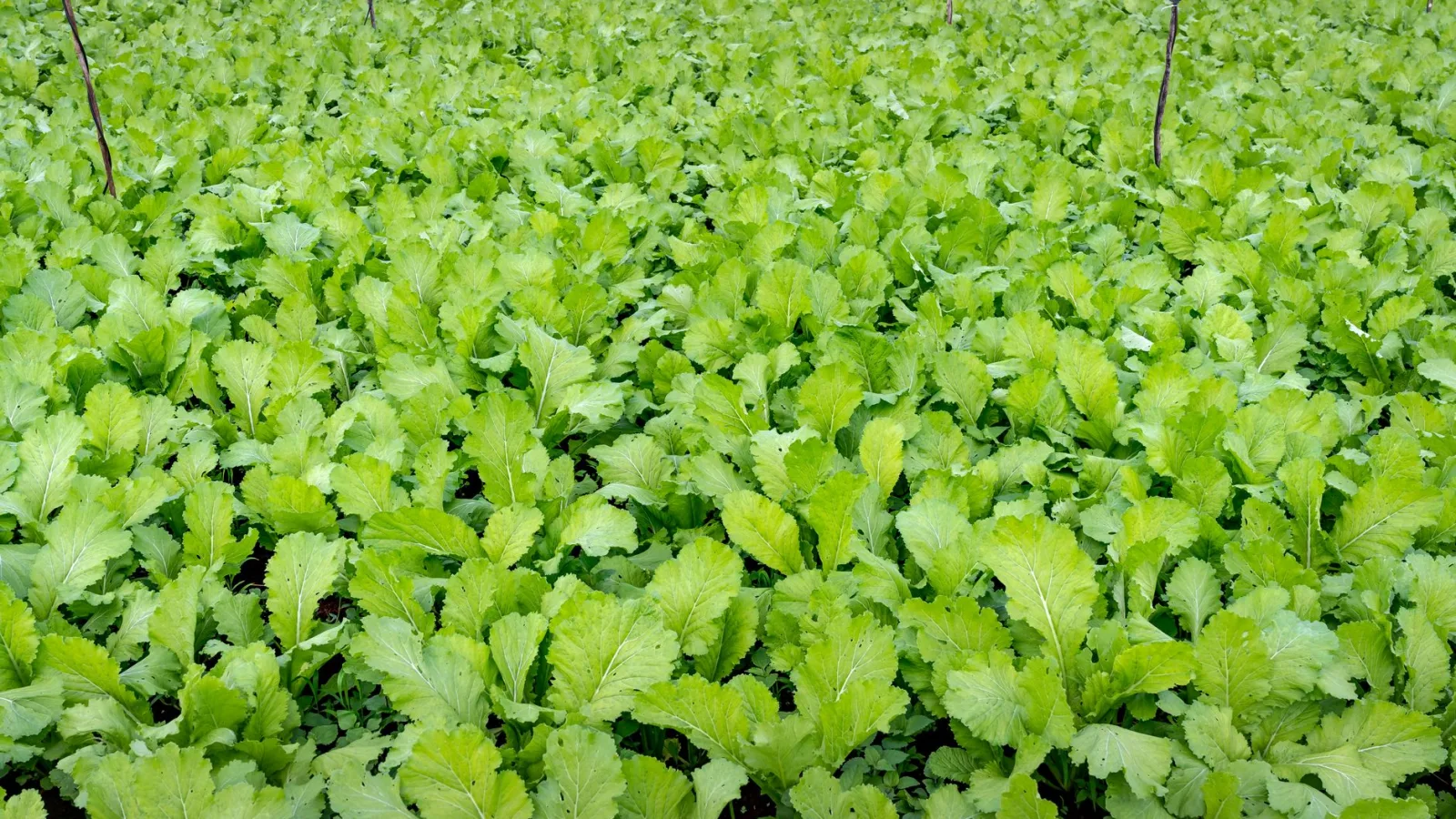
Korean radish (mu) is a root that turns sharp under the grater. The pungency is created at the moment of cutting or grating and fades as it stands, so grated radish is best made when it is wanted. Starch-splitting enzymes such as diastase are present, but they are fragile to heat and survive only in uncooked preparations like a raw salad or grated radish. The leafy tops, mucheong, hold more calcium and vitamins A and K than the root, so dried as siraegi nothing goes to waste. Direct-sow in spring or fall; cool-season fall radishes are especially sweet and firm.
Year-Round Calendar
- 1
- 2
- 3
- 4
- 5
- 6
- 7
- 8
- 9
- 10
- 11
- 12
- 4
- 8
- 9
- 6
- 11
Where It Grows
- Main producer Accounts for the bulk of world radish production. Autumn radish from the North China and East China plains is the mainstay.
- Major producer A country where daikon ranks among the top vegetables by output. Production shifts between Chiba, Hokkaido and Kagoshima to supply the market year-round.
- Major producer The long radish known as mooli is grown in two seasons, the rainy season and winter.
- Major producer The small red salad radish dominates. Florida and California are the growing regions, and although it is the same species, it belongs to a different line from the thick East Asian radish.
The prevailing view places its origin somewhere between the Mediterranean coast and Central Asia, but since no single country can be pinpointed, no origin row has been included here. The daikon types, bred for thick roots, branched off in East Asia and grew alongside kimchi, danmuji (yellow pickled radish) and braised dishes, while in Europe and the Americas the small red salad radish dominates — one species used along two lines. The FAO often does not count radish as a separate item, grouping it with other root vegetables, so country rankings are approximate.
- Optimum
- 17~20℃
- Range
- 5~28℃
- Hardiness
- Half-hardy
- Day length
- Long-day
Radish prefers cool weather. Roots swell best when daytime temperatures hover around 20℃; in prolonged heat the flesh turns spongy or sharp-tasting. If young plants go through a cold spell and the days then lengthen, they bolt before the root has had time to thicken.
In Korea Nationwide
Autumn radish is the mainstream. Sown from late August to early September and pulled in November for kimjang, the annual kimchi-making. Midsummer supply comes from highland areas (cool upland farming) such as Pyeongchang and Jeongseon in Gangwon, and winter supply from Jeju's overwintering radish, grown through the cold season in the field.
- 8
- 9
- 1
- 2
- 12
- 3
- 4
- 8
- 9
- 6
- 10
- 11
- 5
- 6
- 8
- 9
How to grow
- Light
- Somewhere sunny
- Soil and depth
- 30cm deep or more, stone-free and loose
- Spacing
- 25cm
- Watering
- Steady. Dry-then-wet gives you split, peppery roots
- Feeding
- Generous base dressing. Never half-rotted manure
- Harvest
- When the shoulder rises above the soil and thickens. Lift before the frosts
What makes the difference. Sow three or four seeds per station and keep the strongest. Transplanting makes the root fork
Common problems
- Flea beetles You will see A scatter of pinprick holes What to do Fleece while young
- Soft rot You will see The base goes mushy and smells What to do Improve drainage; pull affected plants
This page describes how a crop is grown and used. It does not claim health effects for any food, nor is it intended to prevent or treat disease. Component and study notes are references only and do not mean the same result occurs in people. Consult a medical professional about health concerns.
Health Benefits
What the Donguibogam records — names and a caution. The Donguibogam lists radish in its vegetable section as 蘿葍 (nabok), gives 萊菔 as an alternative name, and leaves a line saying it should not be eaten together with rehmannia or fo-ti. This is a historical medical record and differs from modern judgement.
Compositional analysis. Analyses comparing glucosinolate content and antioxidant activity across brassica seeds have reported radish seed among the higher-ranking ones. These are figures on composition and on activity measured in the test tube; they do not mean that eating radish keeps any disease away.
Animal work on a seed extract. This research used an extract drawn from radish seed, which is a different proposition from eating radish as food. In animals fed a high-fat diet, reports describe smaller weight gain and shifts in gut bacterial composition. Nothing has been confirmed in people.
Glucosinolate levels in radish sprouts. Analyses report that radish microgreens carry higher glucosinolate concentrations than the mature root, and the routes by which these sulfur compounds are converted during digestion have been mapped. What can be stated at present stops at composition.
What is in the leafy tops. Analyses comparing radish greens with the root report higher levels of polyphenols, flavonoids and dietary fiber in the leaves. That overlaps with the Korean habit of keeping the tops for siraegi and mucheong kimchi rather than discarding them, but what has been confirmed in modern terms stops at composition.
Nutrition
- Diastase (amylase) (Digestive enzyme) — A starch-splitting enzyme, easily lost to heat
- Vitamin C (Present) — Water-soluble, so long boiling reduces it
- Dietary fiber (Root and leaves) — More of it in the leafy tops
Glucosinolates Korean radish carries glucosinolates, the sulfur compounds common to the Brassicaceae. An intact root is not pungent; the sharpness appears only when cutting or grating breaks the cells and the compounds are cleaved. The reason napa cabbage, mustard greens and cabbage each bite differently is that they carry different members of this family.
Isothiocyanates (ITC) These are the substances formed when glucosinolates are cleaved by the enzyme myrosinase or by gut bacteria. Several forms have been reported from radish, including sulforaphene in the seed, and they appear often in laboratory work on brassica vegetables. Evidence in people is nowhere near as settled as the compositional data.
The moment the heat appears A whole radish root is barely pungent. The instant it is grated or cut, enzyme and compound meet and the pungent substances form; left standing, they escape and the bite fades. That is where the rule about grating radish only when you need it comes from. The pungent compounds are not the same ones found in mustard or wasabi.
Vitamin C, potassium & dietary fiber Vitamin C, potassium and dietary fiber are all present. The vitamin C in the root is water-soluble and heat-sensitive, so long boiling reduces it. The leafy tops hold more calcium and vitamins A and K than the root, which sits well with the tradition of drying them for siraegi rather than throwing them away.
Digestive enzymes Starch-splitting enzymes such as diastase (amylase) are present. They are fragile to heat and lose activity on cooking, so they survive only in uncooked preparations like a raw salad or grated radish. That overlaps with the custom of serving radish alongside rice cake and dumplings, but no body of evidence measures how much digestion actually changes in a person who eats it.
Pairings
○ Rice cakes & wheat-based foods — Because radish's diastase helps break down starch, adding radish to tteokguk (rice-cake soup) or serving grated radish alongside dumplings has long been a Korean tradition. The reasoning: it provides a natural enzyme boost that lightens the digestive load of heavy carbohydrates.
○ Rich & fatty foods, meat — Radish helps the body digest fat and protein — which is exactly why it's an essential ingredient in galbitang (beef short-rib soup) and other meat broths. Its fiber and enzymes work together to lighten a heavy meal.
○ Fish — Radish tames the fishy smell of seafood and aids detoxification. That's why a chunk of radish is a staple in Korean braised fish dishes — the pungent sulfur compounds in radish neutralize the substances that cause the fishy odor.
○ Honey — Combining radish juice with honey is a traditional home remedy for a dry cough. Radish's cooling nature soothes heat in the throat, while honey coats and protects the mucous membranes to ease irritation — a complementary pairing.
○ Asian pear — Drinking the blended juice of radish and Asian pear is a Korean folk remedy for respiratory wellness. Both ingredients are high in water and have a cooling nature, so the combination relieves dryness and heat in the throat at the same time. Asian Pear
△ Ginseng — The Donguibogam, a classic Korean medical text, lists radish and ginseng as a pair to keep apart (sang-o). The old reasoning was that radish works against what ginseng is taken for, and the customary advice that follows from it is to leave an hour or two between raw radish and ginseng tea or red ginseng. This is a record from an old medical text and is not a statement about how either food acts in the body. Korean ginseng
△ Tonic herbal medicines such as rehmannia, fo-ti, and horny goat weed — While taking traditional Korean tonic medicines, it's recommended to avoid raw radish and radish seeds. This follows the traditional view that radish's qi-lowering (descending) action works against the strengthening effect of tonic herbs. Korean Epimedium · Fleeceflower · Rehmannia
△ Pork + large amounts of raw radish (disputed) — Some herbal texts in the Donguibogam tradition consider pork with large amounts of raw radish a poor match, but at everyday dietary levels it's perfectly fine. Modern nutrition science, in fact, suggests radish actually helps digest the fat in pork—worth keeping in mind alongside the traditional view.
Varieties
- Joseon mu (Korean radish) — Fall kimjang radish; firm and dense
- Chonggak mu (altari) — Used for chonggak kimchi (ponytail radish kimchi)
- Yeolmu — Young summer radish; used for yeolmu-kimchi, a refreshing summer kimchi
Source: Rural Development Administration · Food and Nutrition Information