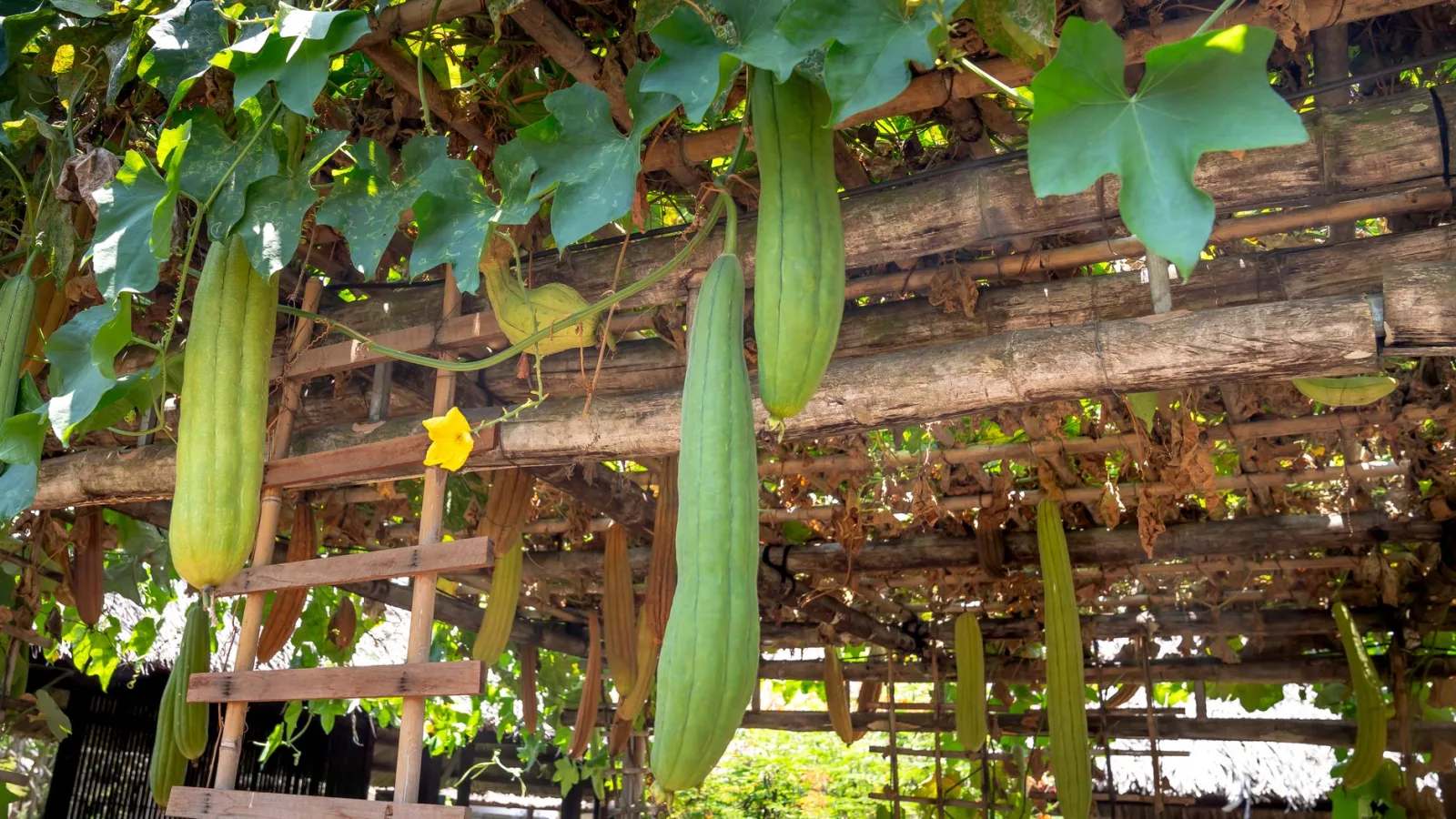
At the tail end of August, fruits hang long beneath the vine we trained up as a shade cover. What measured 15 cm a few days ago has already passed 40 cm. The leaves have spread wide enough to block the sun, and standing underneath and looking up at the fruit, the same question always comes to mind. Can I eat this?
Luffa (Luffa aegyptiaca) is an annual vine in the gourd family. When the fruit ripens, nothing is left inside but cellulose fiber, and that fiber, dried, becomes the sponge you scrub dishes with. It's grown widely in China, India, Vietnam, Guatemala, and Egypt; in the Northern Hemisphere, the seed goes in around April or May and the harvest runs from July through October. When we planted at the start of summer, the plan was sponges. But once the fruit starts setting, you get curious about the eating side. Fruits you can eat and fruits you shouldn't hang on the same vine, so it pays to sort them out from the beginning.
If it tastes bitter, that fruit goes in the trash
Every so often a gourd-family plant throws an individual loaded with cucurbitacin. In luffa, triterpenoid saponins also build up as the fruit matures. Both taste bitter. So before you cook, shave a thin slice off the end and taste it. If the bitterness is unmistakable, spit it out and throw the whole fruit away. Eating much bitter gourd-family fruit brings on vomiting and diarrhea.
Burying the bitterness under seasoning is not the answer. A generous pour of soy sauce or a spoonful of sugar will get it down your throat, but the amount going into your body doesn't change. Most of the other fruits on the same vine will be perfectly fine, so it ends with tossing one.
Pick them under 20 cm
Luffa builds fiber inside as it grows. A fruit past 20 cm, one where you can feel that fiber, is not an eating fruit. It won't break down no matter how long you chew, it doesn't digest, and the saponins have climbed enough to bring bitterness with them. That holds even when the skin is still green.
The Donguibogam, Korea's seventeenth-century medical compendium, records this vine as sagwa (絲瓜, "silk gourd") and notes that dried ones have the skin and seeds removed and the inner flesh used to scour dishes (枯者去皮及子, 用瓤滌器). The young ones boiled and eaten, the dried ones put to scrubbing — both uses set down in the same place. So divide the fruit up as it sets. Tie a length of string on the branch carrying fruit you mean to eat, and leave the ones you're growing for sponges untouched on the vine. Sowing and harvest months, nutrients, and what it pairs with are gathered in the luffa entry in the crop guide.
Seeds and sap don't go in your mouth
The seeds are where the saponins concentrate. Even when you're working with a young fruit, if the seeds have hardened, scrape them out with a spoon. Eaten as they are, they'll leave you uncomfortable.
The sap you draw by cutting the stem contains mucilaginous polysaccharides, and it has a long history as a skin toner. Drinking it is another matter, and not one we'd recommend. There are studies that analyze luffa's saponins and mucilage and measure antioxidant activity, but nearly all of them were done inside a lab, and nothing has been confirmed in people. Which is to say there's no basis yet for drinking it and expecting your body to benefit.
Cook the edible ones briefly
The Donguibogam says young fruit was boiled and eaten with ginger and vinegar. Luffa runs bland on its own, so aroma and a little acidity are what pull the flavor into focus. That advice still holds up today.
- Blanched: peel thinly, blanch for under 3 minutes, and serve it with ginger and vinegar.
- Stir-fried: it releases a lot of water, so take it fast over high heat with something quick-cooking like egg or shrimp. This is the most common treatment across Chinese kitchens.
- In soup: sliced thin into doenjang-guk (soybean-paste soup) in place of summer squash, it drinks up the broth beautifully. Long boiling turns it to mush, so add it right before you cut the heat.
Today, take just one fruit off the vine, something under 20 cm. Cut the end, taste it, and if it isn't bitter, it goes into tonight's soup; if it is, it goes in the trash. Leave the long ones hanging until frost, and once the skins have dried, bring them in as sponges.