
- Type
- Leafy Greens
- Difficulty
- Easy
- Season
- Spring
- Sowing
- Root division
Butterbur (Meowi)
Petasites japonicus
Petasin · a bitter spring green eaten for its stalks
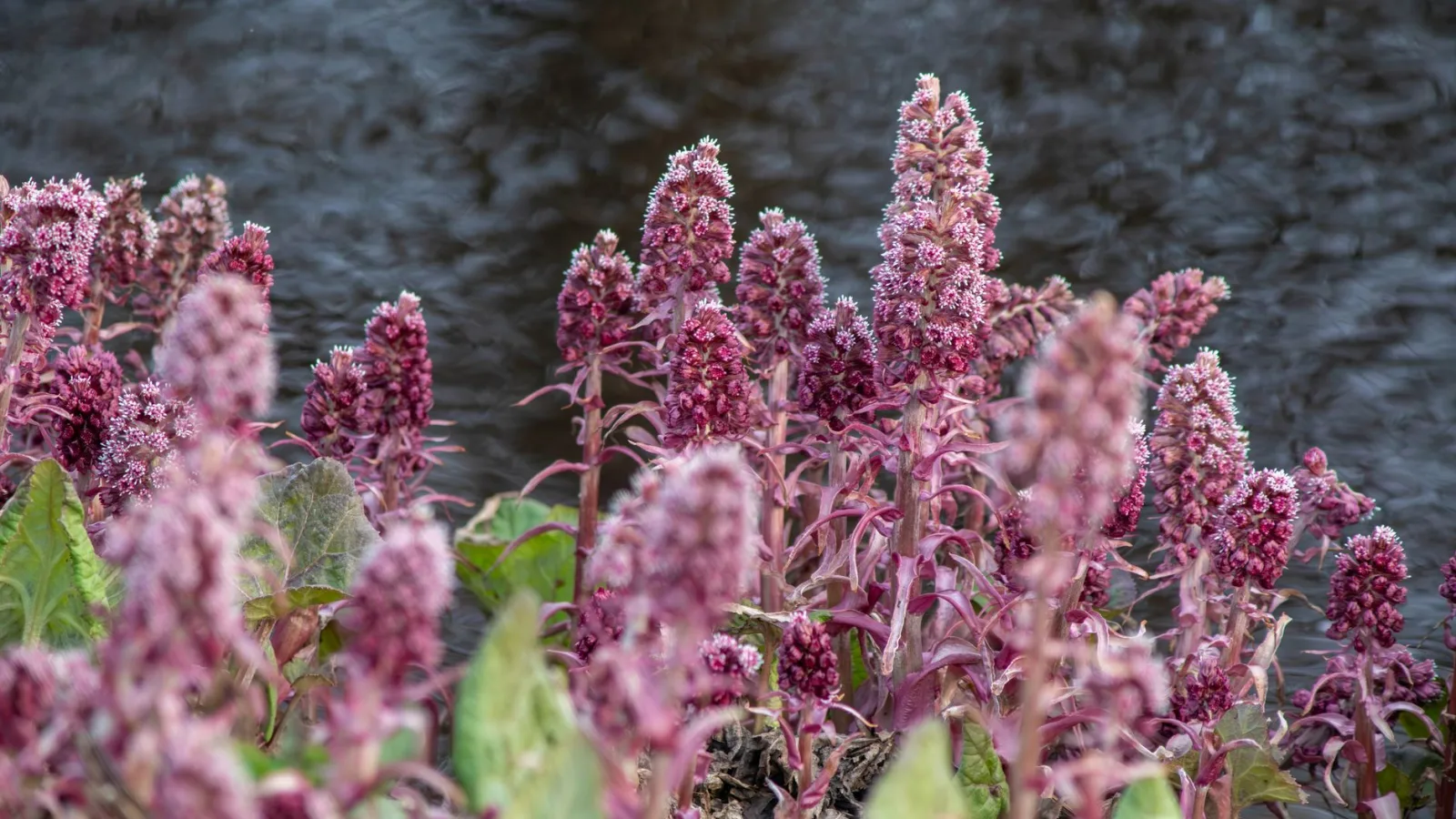
Butterbur (meowi in Korean) is a bitter spring green prized for its broad leaves and crisp leaf stalks, called meowit-dae, which Koreans cook into namul side dishes and perilla-seed soup. Traditional Korean medicine handled it under the medicinal name bongduchae, but that is what the old records wrote, not a judgment for today. Coltsfoot flower (gwandonghwa), whose old medicinal name is easily mixed up with it, is a different plant and should not be confused with butterbur. The one to watch for when gathering is the leopard plant (Farfugium japonicum), an evergreen with thick, glossy leaves. Its leaf shape is close to butterbur's, but it is not a green to eat, it carries pyrrolizidine alkaloids of its own, and poisonings have been reported from mistaking it for butterbur. Butterbur leaves are thin and matt and die back for the winter, so leave any clump whose thick, shining leaves are still in place through the cold months. Plants of the Petasites genus hold trace pyrrolizidine alkaloids, known to burden the liver, so blanch the stalks and leaves in boiling water, soak them well in cold water before cooking, and do not eat large amounts over a long stretch. Anyone pregnant, breastfeeding, or living with liver disease should avoid it.
Year-Round Calendar
- 1
- 2
- 3
- 4
- 5
- 6
- 7
- 8
- 9
- 10
- 11
- 12
- 3
- 4
- 5
Where It Grows
- Main producer Known there as fuki, it has become an established field crop in areas such as Aichi and Gunma.
-
Main producer
It is grown in fields along the southern coast of South Gyeongsang Province; elsewhere, wild plants growing on mountain foothills are gathered. Harvest April, May
- 4
- 5
- Wild population It grows on moist foothills and in valleys of the northeast and east.
Native to the moist temperate forests of East Asia across Korea, Japan, and China, it cannot be traced to any single country. Commercial field cultivation is almost entirely confined to Japan and Korea, and with no separate international production statistics, countries cannot be ranked.
- Optimum
- 15~23℃
- Range
- 5~28℃
- Hardiness
- Hardy
It favors cool, moist partial shade. When the summer sun is strong its broad leaves scorch; in winter the foliage dies back and the plant retreats into its underground rhizomes, sending up new growth in early spring the following year.
Harvested 1–2 years after planting. When rhizomes are planted in spring, the plants produce few leaves that first year, but from the following year onward they come up in the same spot every year. Once established, a planting lasts for many years, spreading sideways through its roots.
In Korea Nationwide
It grows on moist foothills, field banks, and ditch sides throughout the country, and is cultivated in fields along the southern coast. Flower buds are harvested in February–March, and leaves and leaf stalks in April–May.
How to grow
- Light
- Part shade. Strong sun scorches the leaves
- Soil and depth
- Somewhere damp, 25cm deep
- Spacing
- 40cm. It spreads sideways
- Watering
- Do not let it dry
- Feeding
- Once in spring
- Harvest
- Early spring, the flower buds and the young leaf stalks
What makes the difference. Once settled it spreads by root and keeps going. Do not plant it where spreading would be a problem
This page describes how a crop is grown and used. It does not claim health effects for any food, nor is it intended to prevent or treat disease. Component and study notes are references only and do not mean the same result occurs in people. Consult a medical professional about health concerns.
Health Benefits
The old record: bongduchae (蜂斗菜). In traditional Korean medicine butterbur was handled under the medicinal name bongduchae (蜂斗菜). What can be said here stops at the fact that the old records entered the plant under that name; it differs from present-day judgment. Coltsfoot flower (gwandonghwa, 款冬花), whose old medicinal name is easily mixed up with it, is a different plant and should not be confused with butterbur.
What today can confirm: the human studies used another species' extract. The studies in people that examined petasin have mostly used standardized extracts of European butterbur (Petasites hybridus), which differs in both species and conditions from eating the butterbur (Petasites japonicus) served as a namul green. Nothing has been confirmed by modern research for butterbur eaten as a food, and what can be stated now stops at composition.
Handling caution: pyrrolizidine alkaloids. Plants of the Petasites genus contain trace pyrrolizidine alkaloids, which are known to burden the liver. Blanch the plant in boiling water, soak it well in cold water before cooking, and do not eat large amounts over a long stretch. Anyone pregnant, breastfeeding, or living with liver disease is safer not eating it at all.
Nutrition
- Petasin (A sesquiterpene) — The compound behind the bitter edge
- Vitamins and minerals (In the leaves and stalks) — Micronutrients held in the leaves and stalks
- Pyrrolizidine alkaloids (Trace amounts) — The compounds reduced by blanching and soaking
Petasin and the bitter compounds These sesquiterpene compounds create butterbur's bitter edge. Research on petasin has mostly used extracts of European butterbur, so it cannot be carried over to the butterbur eaten as a namul green. The bitterness is reduced by blanching and soaking.
Vitamins and minerals The leaves and stalks contain vitamins and minerals, and butterbur is enjoyed as a spring namul green. What can be stated stops at composition; there is no research in people to support anything beyond that.
Pyrrolizidine alkaloids These alkaloids, present in trace amounts in plants of the Petasites genus, are known for liver toxicity, and several countries treat their level in food as something to be controlled. That is why the plant needs to be blanched in boiling water and soaked well in cold water, and why anyone pregnant, breastfeeding, or living with liver disease should avoid it.
Pairings
○ Perilla seed (butterbur perilla soup) — Meowit-dae stalks simmered with ground perilla seeds make deulkkae-tang, a springtime favorite in which the bitterness of the butterbur balances the nutty richness of the perilla. Perilla (Deulkkae)
○ Doenjang (butterbur namul) — Tossing blanched butterbur leaves with doenjang, Korean fermented soybean paste, mellows their bitter edge.
○ Blanching (to draw out bitterness) — Blanch in boiling water and then soak in cold water to reduce the bitter, astringent taste and make the greens more palatable.
△ Do not confuse it with the leopard plant — The leopard plant (Farfugium japonicum), an evergreen with thick, glossy leaves, has a leaf shape close to butterbur's but is not a green to eat. It carries pyrrolizidine alkaloids of its own, and poisonings have been reported from mistaking it for butterbur. Butterbur leaves are thin and matt and die back for the winter, while the leopard plant keeps its thick, shining leaves right through the cold months. Leave any clump with thick, glossy leaves, and any clump you cannot name with certainty.
△ Go easy on raw or large servings — Butterbur and some of its botanical relatives can contain trace amounts of pyrrolizidine alkaloids. Rather than eating it raw in large quantities, the safer approach is to blanch it, soak it in water to draw out the compounds, and enjoy it in moderation.
Varieties
- Native Korean butterbur (Bulb) — Spreads on its own in damp shade. Thin stalks with a strong bitter scent and firm bite.
- Thick-stalked grown line (Bulb) — Stalks grow longer and fatter than the native type. Peeled before braising or soup.
Source: Rural Development Administration (Nongsaro) · traditional herbal texts (bongduchae, the herbal name for butterbur)