

- Type
- Tubers & Storage Roots
- Difficulty
- Easy
- Season
- Summer
- Sowing
- Transplant
Sweet Potato
Ipomoea batatas
Beta-carotene and fiber - a sweet-tasting tuber
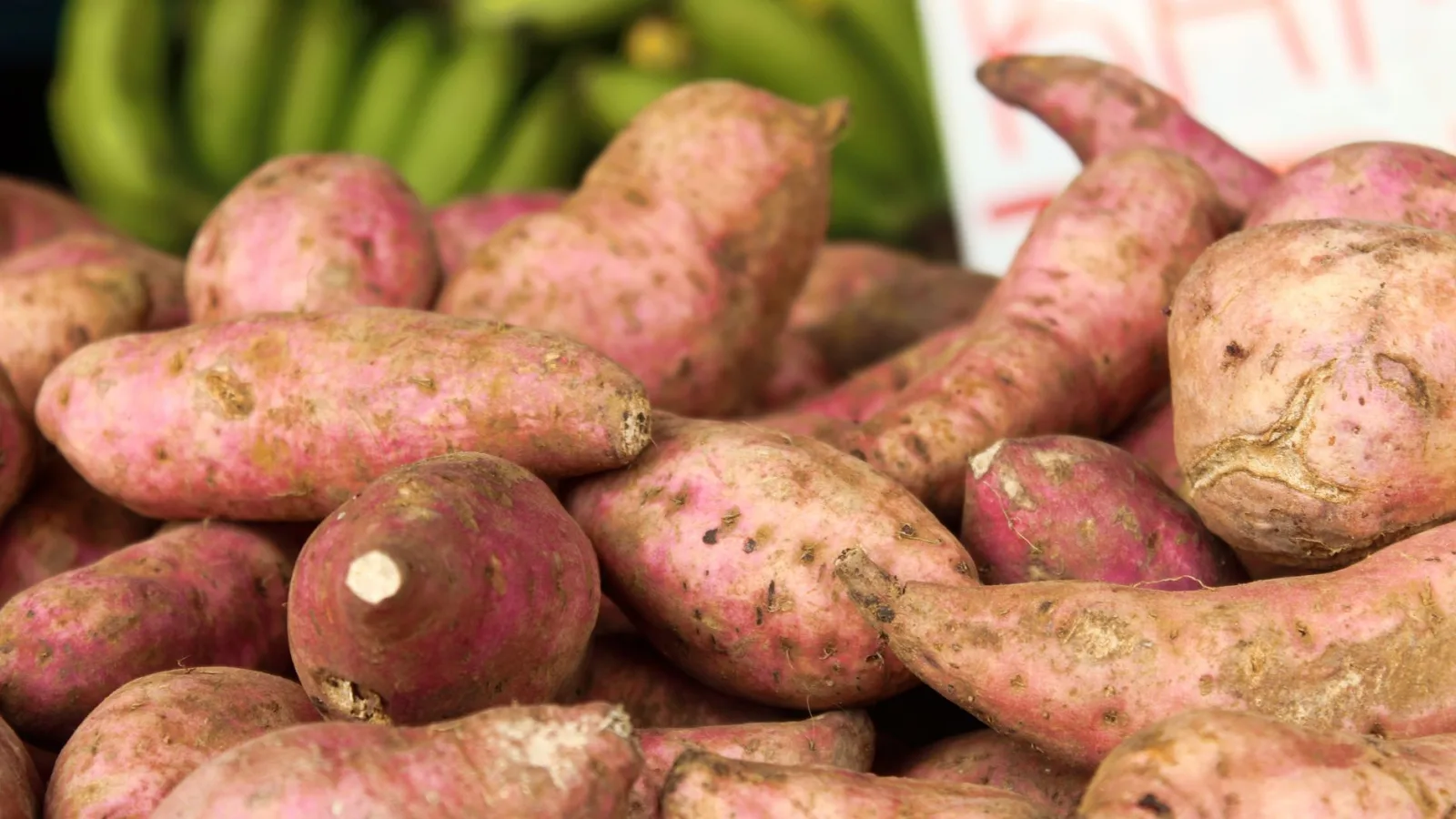
Sweet potatoes are high in dietary fiber, and a freshly cut surface weeps a milky white sap called jalapin. Orange-fleshed varieties (known in Korea as hobak goguma, or "pumpkin sweet potato") carry beta-carotene deep enough to color the flesh, while purple sweet potatoes hold anthocyanins. Cooking and then cooling them raises the resistant starch fraction, which changes the texture as well. Plant slips in May or June and harvest in mid-October.
Year-Round Calendar
- 1
- 2
- 3
- 4
- 5
- 6
- 7
- 8
- 9
- 10
- 11
- 12
- 5
- 6
- 10
Where It Grows
-
Main producer
Produces more than half of the world's output. The Sichuan, Henan and Shandong areas are the centre of it. Harvest September, October, November
- 9
- 10
- 11
- Main producer Africa's largest producer and second in the world. It is grown as a staple crop second only to maize.
- Major producer The centres are the southern shore of Lake Victoria and the evenly rained western highlands.
- Major producer Grown in the central savanna belt, and almost all of it is eaten domestically.
- Major producer On the equatorial plateau the rains come in two separate spells, so the crop is planted twice and lifted twice in a single year.
Its origin lies in tropical America, spanning Central America to northern South America; because it cannot be pinned to a single country, no country-of-origin row has been created. From the 16th century onward it travelled on European ships to Asia and Africa, and it reached the Korean peninsula in 1763, brought in by Jo Eom by way of Tsushima. The countries that grow the most today are not the crop's homeland but are concentrated in East Asia and sub-Saharan Africa.
- Optimum
- 22~30℃
- Range
- 15~35℃
- Hardiness
- Not hardy
- Day length
- Short-day
This is a heat-loving crop. Soil temperature must climb above 15℃ before the slips will root, the storage roots swell at 22–30℃, and a single frost kills the stems and leaves. It flowers only under shortening day length, so the blooms are rarely seen in temperate regions.
In Korea Nationwide
It will grow anywhere in the country given good sun and well-drained sandy loam. Haenam and Yeongam in South Jeolla, Nonsan and Dangjin in South Chungcheong, and Yeoju in Gyeonggi are the known districts. In the south, growers cover the beds with plastic film to plant early in April and lift the first new sweet potatoes in July and August.
How to grow
- Light
- It wants a lot of sun
- Soil and depth
- 30cm deep or more, sandy and free-draining
- Spacing
- 30cm
- Watering
- Attention for the first fortnight; almost none after that
- Feeding
- Feed it well and you get vine and no tuber. Go light even on the base dressing
- Harvest
- Before the frosts, once the leaves yellow
What makes the difference. Wherever a vine touches soil it roots, and the plant's energy scatters. Lift the vines off the ground now and then
Common problems
- Chafer grubs You will see Gnaw marks on the tubers What to do Avoid half-rotted compost
This page describes how a crop is grown and used. It does not claim health effects for any food, nor is it intended to prevent or treat disease. Component and study notes are references only and do not mean the same result occurs in people. Consult a medical professional about health concerns.
Health Benefits
The distance between extract studies and food. The trials cited alongside blood sugar gave measured doses of an extract drawn from white sweet potato (Caiapo), which is not the same condition as eating sweet potato as food. What was observed with an extract cannot be carried over to a single steamed sweet potato.
What the Cochrane review concluded. These were studies of an extract, a different condition from eating the food itself. A Cochrane review concluded that the trials on sweet potato extract were few and limited in quality, so the evidence at hand was not enough to recommend it.
Composition. Composition analyses confirm that sweet potato holds beta-carotene, dietary fiber and potassium, and that purple varieties carry anthocyanins as well. Studies feeding the food itself to people are scarce, so what can be said for now stops at composition.
Resistant starch in cooled sweet potato. That resistant starch increases in sweet potato once it has been cooked and then cooled is established as a property of starch. That is not to say it bears on any particular disease.
Nutrition
- Beta-carotene (Abundant (especially in orange-fleshed varieties)) — The pigment behind the orange color
- Dietary fiber and jalapin (Abundant) — The milky sap that beads on a cut surface
- Potassium (Abundant) — A mineral common in vegetables
Beta-carotene (β-carotene) Yellow and orange sweet potatoes, especially the hobak (pumpkin) type, carry a heavy concentration of beta-carotene that places them among the top vegetables for this pigment. It is a pigment the body converts into vitamin A, and sweet potato ranks among the foods richest in that precursor.
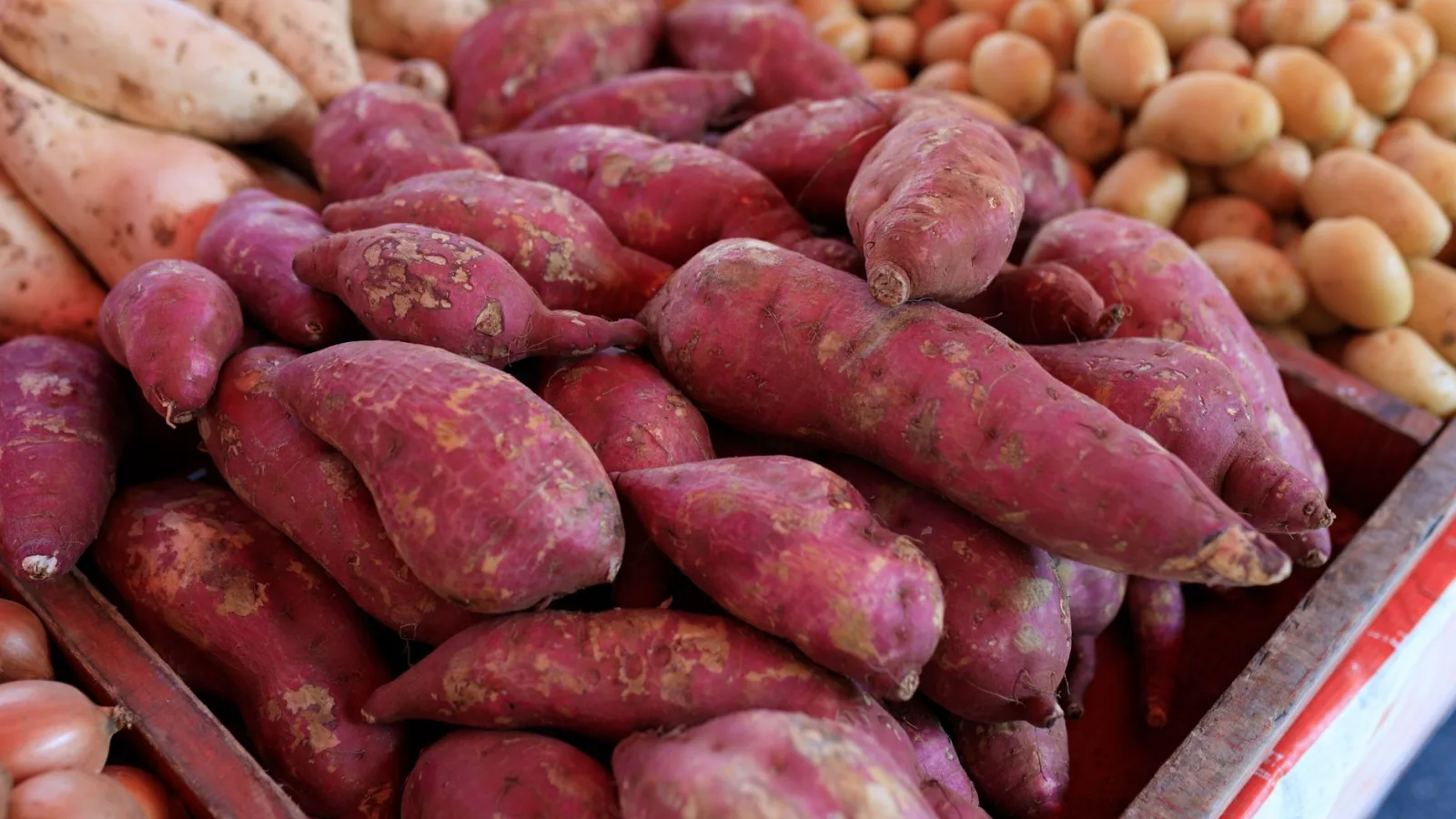
Anthocyanins Purple sweet potato is rich in anthocyanins, an antioxidant pigment. The deep color raises its polyphenol content, which sits a step above that of ordinary sweet potato.
Dietary fiber Sweet potato holds about 3 g of dietary fiber per 100 g including the skin, with soluble and insoluble forms distributed in balance. Washing it clean and eating it skin and all raises fiber intake considerably.
Resistant starch (cooled sweet potato) Cooled sweet potato forms resistant starch, which passes through the small intestine undigested and reaches the large intestine. It feeds the gut microbes and ferments into short-chain fatty acids, and the rise in that fraction after cooking and cooling is established as a property of starch.
Vitamin C, B6, manganese & potassium Vitamin C and B6 along with manganese and potassium are present in generous amounts. A single meal of sweet potato supplies several micronutrients at once, making it a nutrient-dense food.
Chlorogenic acid & phenolic acids Chlorogenic acid and phenolic acids, antioxidant polyphenols, are contained in sweet potato. Together with the carotenoids they make up the antioxidant fraction of the root.
Caiapo (white sweet potato extract) Caiapo, examined in Japanese and German studies, is an extract drawn from white-skinned sweet potato, different in both form and amount from the sweet potato eaten as food. Results from trials on the extract should not be read across as properties of the vegetable itself.
Leaves (sweet potato stems) Sweet potato leaves and stems are rich in beta-carotene, lutein, and dietary fiber. Korean tradition has used them as an autumn delicacy vegetable, commonly enjoyed dressed with perilla powder or in perilla soup.
Pairings
○ Milk, yogurt, and cheese — Sweet potato latte or sweet potato gratin supports the fat-soluble absorption of beta-carotene while adding protein and calcium. It's a way to turn a plain sweet potato into a nutritionally balanced meal.
○ Butter and olive oil — Adding butter or olive oil when you roast or mash sweet potatoes greatly aids carotene absorption. The nutritional basis is that fat binds with carotenoids to raise their absorption in the gut.
○ Kimchi — In Korean food culture, pairing sweet potatoes with gimjang kimchi (the large batch of cabbage kimchi made for winter) is a classic of fall and winter. The sweetness of the potato contrasts with the salty heat of the kimchi to whet the appetite, and there's added nutritional synergy where a fermented food meets a fresh vegetable.
○ Multigrain rice and beans — Adding multigrain rice and beans to sweet potato complements its protein and amino acids. The beans fill in the amino acids that grains lack, and the sweet potato's vitamins and minerals come together in one balanced bowl. Soybean
○ Cinnamon and ginger — Adding cinnamon and ginger to sweet potato desserts or lattes is a classic use of warming spices. The warming nature of both spices brings out the sweet potato's mellow sweetness, with anti-inflammatory action added as a bonus. Cinnamon · Ginger
○ Sweet potato stems (leaf stalks) — Sweet potato stems are a fall delicacy enjoyed dressed with perilla seed powder or in a perilla seed soup. The alpha-linolenic acid in perilla meets the carotenoids in the stems, showcasing the nutritional wisdom of Korea's autumn food culture.
△ Kidney failure — Sweet potatoes are rich in potassium, so people with kidney failure should limit how much they eat. When the kidneys can no longer clear potassium efficiently, the mineral can build up in the body and raise the risk of serious complications.
△ Sensitive stomach — Eating a large amount of sweet potato can leave people with weak digestion feeling bloated and gassy. Keeping portions moderate and cooking the sweet potatoes until fully soft helps ease the load on the stomach.
△ Fried preparations (chips and fritters) — Sweet potato chips and fritters add the burden of trans fats and acrylamide. The same sweet potato stays a genuinely healthy food when you roast or steam it instead.
Varieties
- Orange-fleshed sweet potato (hobak goguma) — Rich in beta-carotene, moist texture
- Chestnut sweet potato (bam goguma) — Dry, fluffy, and sweet
Source: Rural Development Administration; food and nutrition references
Stories about Sweet Potato
What a Spoonful of Black Rice Does in Your Rice Cooker
The spoonful of black rice that turns your rinse water purple is doing more than adding color. Here's what black and red rice offer that white rice doesn't, and how to cook them well.
Golden-Fleshed Sweet Potatoes: Can the Harvest Grow Along with the Color?
Deep-orange sweet potatoes are richer in carotenoids, but they've traditionally come with smaller roots and thinner harvests. New breeding work published in 2026 produced two lines that improved on both — and pointed to a gene that helps explain why.