After a September feast of late-season peaches, you're usually left with a few wrinkled pits on the plate. Crack open the hard shell and you'll find a flat kernel wrapped in a thin brown skin. Traditional Korean medicine calls this kernel doin (桃仁) and used it as a separate medicinal ingredient. Modern analysis, however, has found that the kernel contains amygdalin, a compound that can release cyanide. That's why it should never be eaten as food.
Before you can harvest peaches, you have to grow the tree. You'll need to keep an eye on both winter cold and summer humidity, so peaches are on the harder side to grow.
Planting from Saplings
Peaches are usually grown from nursery saplings rather than from seed. In the Northern Hemisphere, plant them in March or November, while the trees have no leaves. The peach is native to China and is widely grown in Spain, Italy, Türkiye, Greece, and the United States. Compare your local climate with the growing regions of those countries to judge whether a peach tree will do well where you live.
The peach is a deciduous fruit tree, so it needs a certain number of hours of winter cold before its flower buds will open properly the next year. That's why peaches rarely fruit in the tropics, where there's no winter. The trees grow at 10–32°C and do best at 20–25°C. They don't tolerate long summer rainy seasons or humidity well, so the ideal spot is a slope with little rainfall and good drainage. When you're choosing a site, check first whether water pools there the day after it rains.
Watching for Frost and Excess Moisture
A late frost around bloom time will cut that year's crop. Once the flower buds start to swell in spring, check the overnight low in the forecast. On nights when frost is predicted, covering young trees with frost cloth can reduce the damage.
If the soil stays wet for long stretches in summer, the tree can easily weaken. When rain goes on for several days, dig a drainage trench so water doesn't pool around the base of the tree.
Harvest the Fruit, Discard the Pits
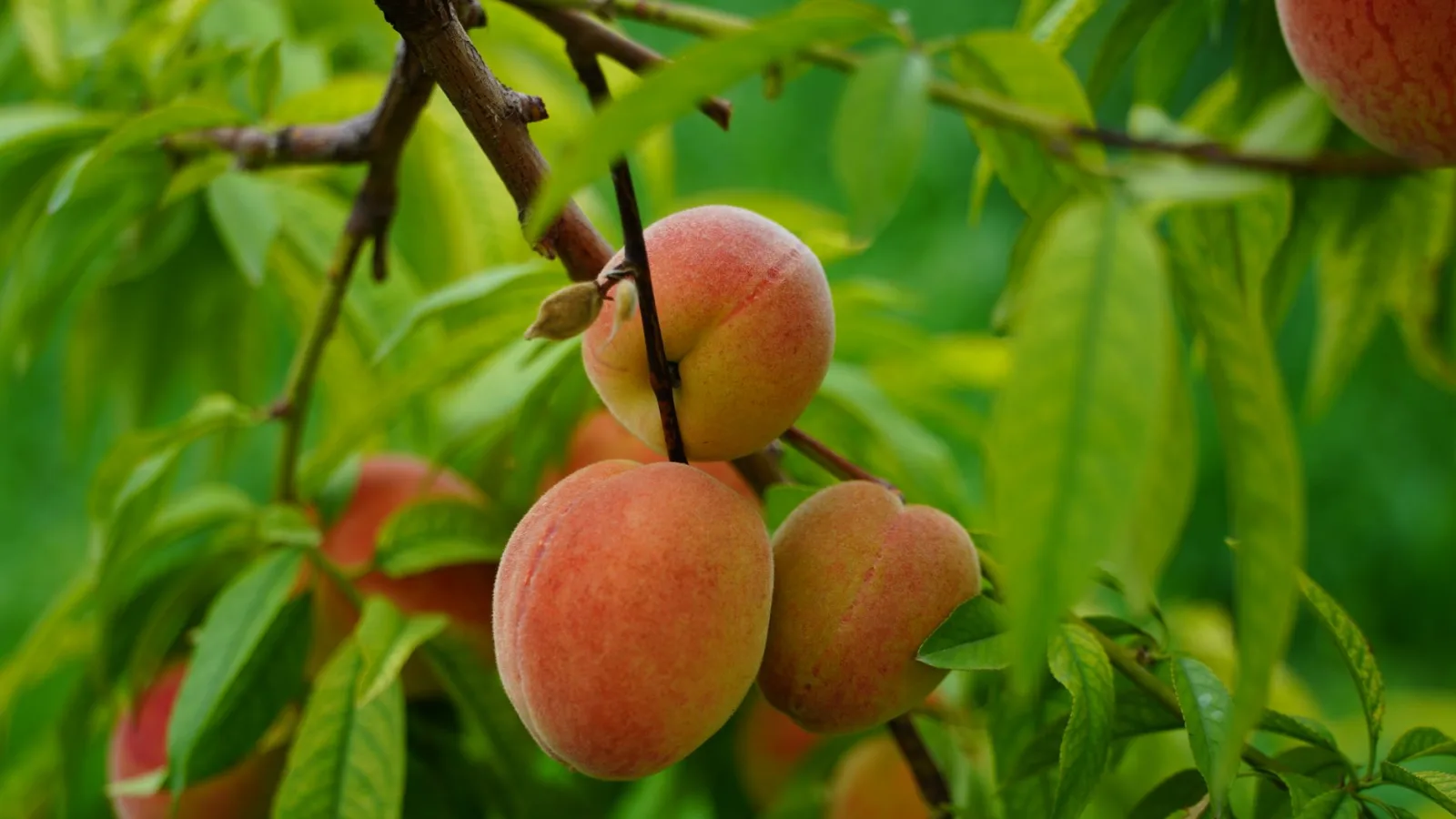
In the Northern Hemisphere, peaches are harvested from July to September. Now, in September, it's time to pick the late-ripening varieties. The part you eat is the flesh. Slice a ripe peach over plain yogurt, and the yogurt's tang balances the fruit's sweetness. Like figs, peaches also pair well with salty cured ham or aged cheese.
When you've finished the flesh, throw the pit away whole, without cracking the shell. Don't leave pits sitting on the table, where a child might pick one up and bite into it. The kernel contains amygdalin along with emulsin, an enzyme that breaks amygdalin down. Crushing or chewing the kernel lets the emulsin break down the amygdalin, which can produce hydrogen cyanide. Amygdalin also releases cyanide when it breaks down inside the body. Several food safety agencies have warned that eating crushed kernels can expose you to cyanide.
If you have crushed or chewed a kernel and swallowed it, don't wait for symptoms. Contact emergency medical services or a poison control center right away.
Historical Records and Modern Guidance
The Donguibogam, the classic 17th-century Korean medical encyclopedia, lists this seed in its section on fruits under the name dohaegin (桃核仁). It says to collect the pits in the seventh lunar month and crack them open. The kernels are dried in the shade, soaked in boiling water to remove the skins and tips, and then ground fine. It also says to pick out and throw away ssangin (雙仁), "twin kernels," where two kernels share a single shell. The book's entry on apricot kernels, haenghaegin (杏核仁), goes further and warns that twin kernels can kill a person.
The original text describes the kernel as non-toxic (無毒). But that is what an old medical text recorded. Now that we know the kernel contains amygdalin, don't eat it raw, and don't try the old preparation method at home either.
Sources: Donguibogam, section on fruits, entry on dohaegin; Korea Ministry of Food and Drug Safety guidance on amygdalin
If you ate peaches today, throw the pits away without cracking them. And if you're planning to buy a sapling, first make sure your area gets enough winter cold.