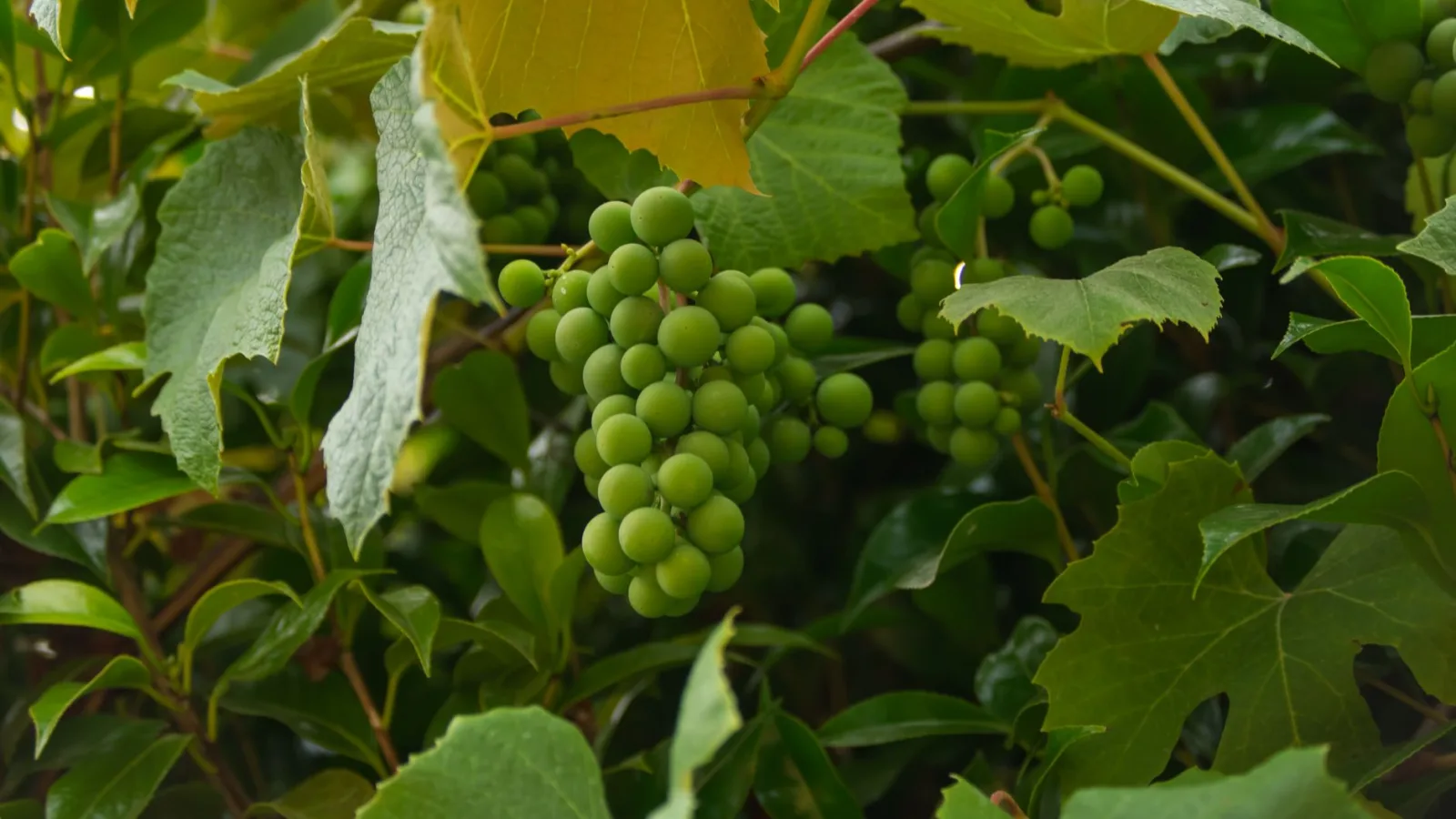
Stand under the vines in August and the clusters hang just below eye level. The berries are swelling and taking on color, so the view changes from one day to the next. Grapes grow on vines, which means that as long as you give them somewhere to climb, a rooftop or a balcony railing will do. Even without a plot of ground, this is a fruit worth trying.
Starting from a young vine
Grapes aren't started from seed. You plant a young vine, and in the Northern Hemisphere that means March or April, or November, after the leaves have dropped. They grow best between 20 and 30°C and keep going anywhere from 10 to 35°C. Because the vine sheds its leaves and rests through winter, it ripens well in places with four distinct seasons. The winter buds of European varieties hold up to around −15°C, and American varieties survive colder than that. When you're picking a spot, start by finding the side that gets the longest stretch of sun.
China, Italy, France, and Spain grow the most, with the United States and Türkiye also producing heavily. In Korea, the vineyards cluster around Gimcheon, Yeongcheon, and Yeongdong. Campbell Early was the workhorse variety for decades; lately Shine Muscat has been gaining ground.
Training the vine and looking after it
First the tendrils need something to grab. Wire mesh on the railing, or two or three strands of heavy-gauge wire, is enough. The catch is how much a vine puts on in a single season — by midsummer the new canes are tangled into one another. Keep two or three of the sturdiest and thin out the rest. Sunlight only reaches every cluster if the leaves aren't stacked on top of each other.
The weather during ripening decides the sweetness. Plenty of sun and little rain build sugar; frequent rain splits the berries and invites disease. So a place under an eave, where the rain mostly misses, is better, and some growers rig a small rain cover directly above the clusters.
Next year's cluster count is settled this summer. Flower buds aren't triggered by day length. They're set together by the sun the vine took in last summer, the cold of winter, and spring temperatures. The pruning you do now, so this summer's leaves never sit in shade, is what carries through to next spring.
When to pick
Harvest runs August through September in the Northern Hemisphere. Take the evenly colored clusters first, cutting each one at the stem with shears. Right after rain the berries split easily, so wait for a day or two of clear weather before you pick. Leave what you've picked unwashed, and rinse it just before eating.
Skins, seeds, and how much to eat
The sweetness in grapes comes from glucose and fructose. The tartness is mostly tartaric acid, the same compound behind the acidity in wine. Dark skins carry anthocyanins; green grapes have almost none. Resveratrol is barely present in the flesh.
The polyphenols in skins and seeds have been through a number of antioxidant studies. Even so, little has been confirmed in people, and the amount you get from eating the fruit is nowhere near the doses used in those experiments. Better to put the pleasure of eating ahead of any hope of health benefits.
The Dongui Bogam, the seventeenth-century Korean medical compendium, writes the grape as 蒲萄 in its section on fruits and calls the purple ones mayu (馬乳, "mare's milk") and the white ones sujeong (水晶, "crystal"). The liquor brewed from the pressed juice it names podoju, grape wine, and the small wild sort growing in the mountains it sets apart as yeong-uk (蘡薁). It adds a caution, too: eat too many at one sitting and your eyes go cloudy. That's a record from an old medical text, not a modern medical judgment.
A few ways to eat them:
- Green grapes, eaten skin and all, are good alongside cheese. Take them out of the fridge about 20 minutes ahead and the aroma comes forward.
- Rinse the berries, pat them dry, and freeze them — you'll eat them slowly, and less at a time. Freeze them with the skins on and the skins slip off easily later.
- When you're roasting chicken or duck, add halved grapes for the last 10 minutes and the juice turns into a sauce. It comes out sweet without any sugar.
Today, go stand under the vine and pull off a few leaves where they're overlapping. This week's clusters will get more sun for it. And the flower buds that open next spring are being decided by this summer's light.
Sources: Dongui Bogam, Fruits section, "Podo" (蒲萄); Rural Development Administration, Nongsaro.