Tangaek — Decoctions · Vegetables
韭菜 Korean Chive (Buchu / Garlic Chive)
 Related Crop · Korean Chive (Buchu / Garlic Chive) →
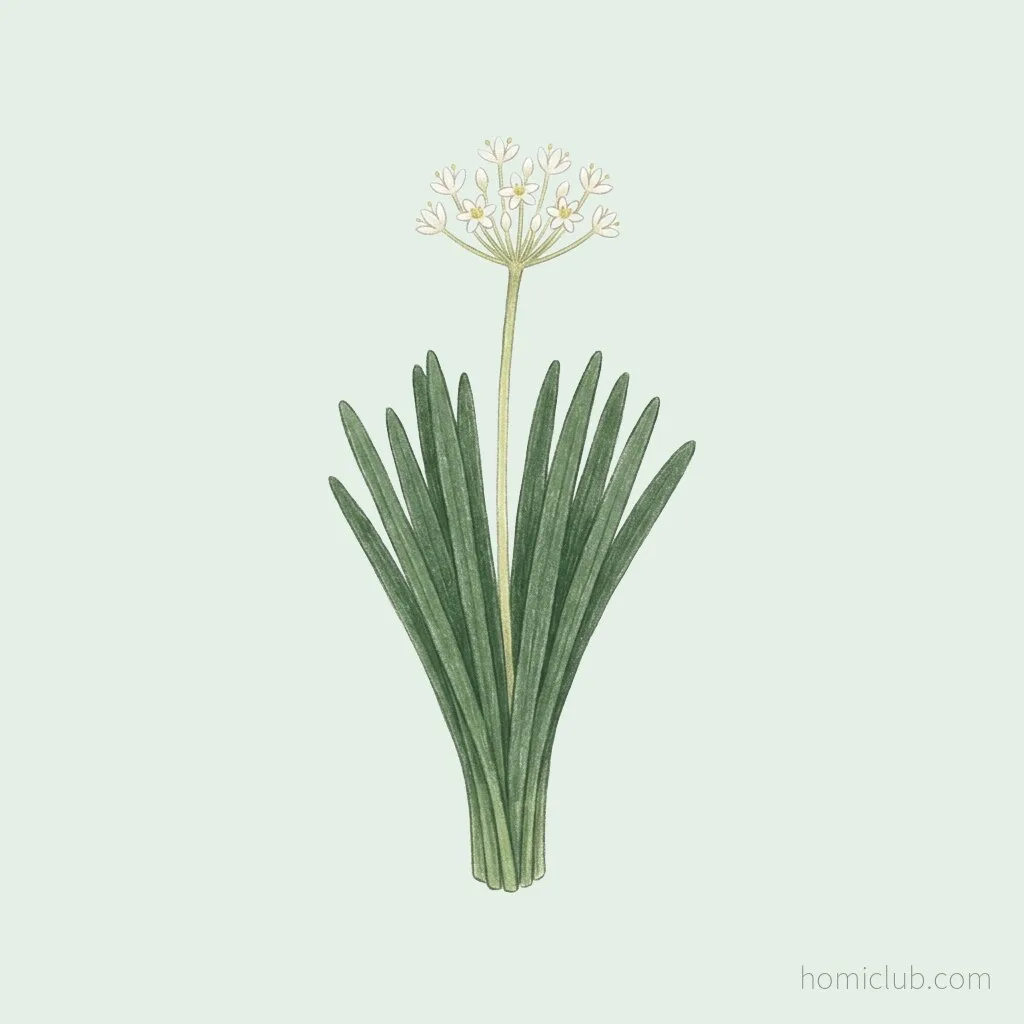
Buchu, garlic chives, holds one bed for years and sends up new leaves each time it is cut. It is the same plant as the buchu in the crop guide, the leaf that goes into savory pancakes, quick salads, and dumpling filling. The Donguibogam traced the character gu to exactly that habit.
Original, read line by line 東醫寶鑑 · Tangaek — Decoctions vol. 2
-
性溫一云熱, 味辛微酸, 無毒.
Its nature is warm, though one account calls it hot; its taste is pungent and slightly sour, and it is non-toxic.
HomiclubThe Korean chive is a perennial allium that holds its place for years once planted. Regional names include jeonguji, sol, and jol, and it is the leaf that goes into chive pancakes and dumpling fillings.
-
歸心. 安五藏, 除胃中熱, 補虛乏, 煖腰膝, 除胸中痺. 《本草》
It returns to the sim (心, heart). It calms the ojang (五藏, five viscera), removes heat within the wi (胃, stomach), supplements depletion and exhaustion, warms the lower back and knees, and removes bi (痺, blockage) within the chest. 《Boncho (本草)》
-
韭能去胸中惡血滯氣, 又能充肝氣. 《丹心》
The Korean chive can remove bad blood and stagnant qi within the chest, and it can also fill out the gangi (肝氣, liver qi). 《Dansim (丹心)》
-
處處有之, 一種而久者, 故謂之韭.
It is found everywhere, and because it is planted once and lasts long it is called gu (韭).
-
圃人種蒔, 一歲而三四割之, 其根不傷, 至冬壅培, 先春而復生, 信乎一種而久者也. 菜中此物最溫而益人, 宜常食之.
When a gardener plants it, cutting it three or four times a year does not injure its root, and if soil is banked up in winter it comes back before spring arrives; truly it is planted once and lasts long. Among vegetables this one is the warmest and most beneficial to people, so it is fitting to eat it regularly.
HomiclubCutting three or four times a year matches how Korean chives are farmed today. Harvests are named by their order, such as first-cut and second-cut, and the first cut of early spring is reckoned the most tender.
-
此物殊辛臭, 最是養性所忌.
This one is exceptionally pungent and rank, and is the thing most avoided in yangseong (養性, nurturing one's nature).
-
取汁服, 或作葅食, 幷佳. 《本草》
Pressing out the juice and drinking it, or making it into jeo (葅, salted pickle) and eating it, are both fine. 《Boncho (本草)》
Related Crop
Korean Chive (Buchu / Garlic Chive) →
Reading on Korean Chive (Buchu / Garlic Chive)
Vegetables — more entries
This is a cultural and historical record from a classical text, not a claim about any food’s effects. Nothing here is a health supplement or intended to prevent or treat disease. Consult a medical professional about health concerns. · Text: Korean Medicine Classics DB · Reading: Homiclub